
Key Takeaways
- Mouse droppings can carry Salmonella and allergens, while roach frass triggers asthma and allergies, so identifying the pest correctly protects your health and points you to the right treatment.
- Roach frass shows up as either loose black specks that smear when wet or short, blunt, ridged pellets, and it collects in tight clusters near hiding spots.
- Mouse pellets are rice-shaped with at least one tapered end, feel smooth all over, and turn up as scattered trails along the paths mice walk.
- The fastest way to tell is by the ends: tapered means mouse, blunt means roach, and ridges along the sides confirm an American roach.
- Connor’s Pest Pros treats both pests across Metro DC and NOVA with same-day or next-day visits, so you can skip the guesswork entirely.
How to Tell the Difference Between Cockroach Poop & Mouse Poop
Cockroach droppings and mouse droppings can look nearly identical from a few feet away, which is where most people go wrong. Large American roach pellets fall into the same size range as mouse droppings, so size alone won’t settle it. You have to look closely at the ends and the texture.
The location also gives you a clue. Mice leave pellets in scattered trails as they move along walls and baseboards, while roaches drop their frass in tight clusters near the spots where they hide and feed. So where you find the droppings can point you toward the pest before you even pick one up.
By the time you’re seeing droppings, the population in your walls is usually bigger than what showed up on the shelf. Below, you’ll find what each type of droppings actually looks like, where it turns up, and the one feature that settles the question in seconds.
Connor’s Pest Pros: Trusted, Family-Owned Pest Control
4.9★ Google Rating | 100% Satisfaction Guarantee

Protect Your Home, Pest-Free:
Get customized, ongoing pest control that adjusts with the seasons, covering everything from ants and spiders to termites, rodents, and bed bugs. Same-day or next-day visits mean fast relief.
What Sets Us Apart:
✓ 950+ 5-star reviews on Google
✓ Family-owned, D.C. metro area
✓ Member of the NPMA
✓ Angi Super Service Award Winner (2024)
✓ 100% Satisfaction Guarantee
Don’t let pests take over your home. Act now.
Request Your Free Estimate →Characteristics of Cockroach Poop
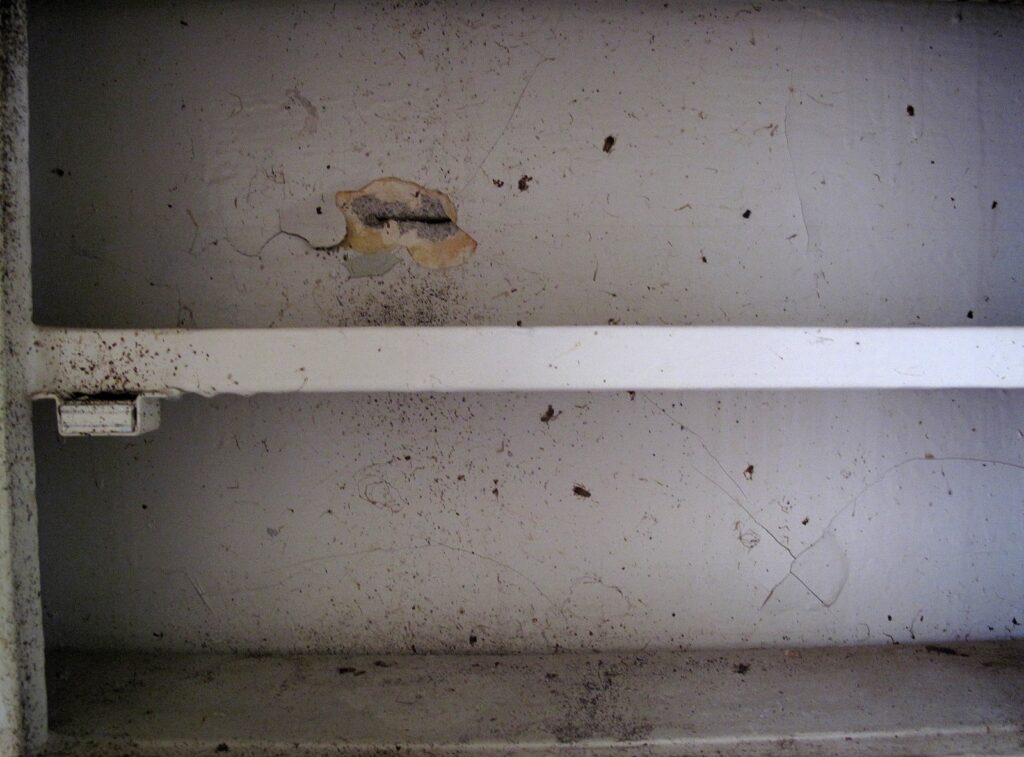
Some cockroach droppings look like coffee grounds. (Image source: “Cockroach Access Hole” by Downtowngal licensed under CC BY-SA 4.0, via Wikimedia Commons.)

Cockroach poop is technically called frass, and it varies more than most people expect. The species of roach, what it’s been eating, and where it’s been living all influence the appearance of its droppings. That said, there are consistent visual markers that separate roach frass from other pest waste.
Roach droppings are strictly composed of digested organic matter. Unlike mouse pellets, they contain zero animal hair. This is one of the most reliable internal distinctions between the two. If you crush a dropping between gloved fingers and find short hairs, you’re very likely dealing with a mouse.
German Cockroach Droppings: Tiny Black Specks Like Coffee Grounds
The German cockroach is one of the most common household roaches in North America, and its droppings look nothing like mouse poop. The roach itself is small, about ½ to ⅝ inch, so its feces are tiny dark specks that resemble coarse coffee grounds or ground pepper.
Look for them clustered in tight spots: kitchen cabinet hinges, the gap beside the stove, behind the refrigerator, and inside electrical outlets. They show up in concentrated groups, not scattered one by one, and heavy infestations leave dark staining on smooth surfaces.
Try the smear test if you are unsure. Dampen a cloth and wipe across the specks. German roach droppings streak into a dark, greasy smear, while ordinary kitchen dirt will not.
American Cockroach Droppings: Blunt Cylinders With Ridged Sides
The American cockroach is a much larger species, typically about 1½ inches long, and its droppings reflect that size. American roach fecal pellets are roughly ⅛ inch long (occasionally approaching mouse-dropping size), cylindrical, and dark brown to black in color. This is where the confusion with mouse droppings becomes most serious, since the two can look similar at a glance.
The critical distinguishing feature is the vertical ridges or grooves running lengthwise along the sides of the pellet, giving it a slightly ribbed appearance similar to a tiny seed or grain. If you see those ridges, you’re looking at roach frass. Both ends of an American roach pellet are also blunt and flat, never tapered.
Where Roach Frass Shows Up in Your Home
Roaches are creatures of habit. They deposit frass in the same areas where they shelter, travel, and feed, which means droppings are a reliable map to their hiding spots. Common locations include:
- Inside and around kitchen cabinets, especially hinges and corners
- Behind and underneath large appliances like refrigerators and stoves
- Under sinks and inside bathroom vanity cabinets
- Along the tops of door frames and in wall voids
- Inside pantry shelving, especially near food packaging
- In basements, crawl spaces, and utility rooms with high humidity
If you’re finding droppings alongside shed exoskeletons or oval-shaped egg casings (called oothecae), that’s a near-certain confirmation of a cockroach infestation. Mice do not shed skin or leave egg cases.
Characteristics of Mouse Poop
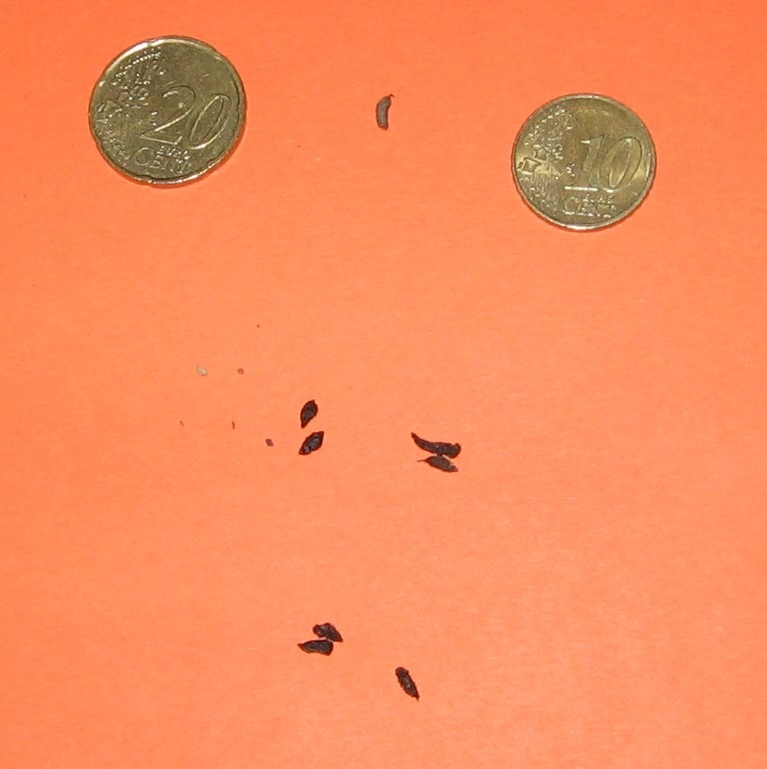
Mouse droppings have distinct pointed edges. (Image source: “Housemouse (Mus musculus) droppings with 10 and 20 euro cent coins, Utrecht, The Netherlands, December 14, 2019” by Hansmuller licensed under CC BY-SA 4.0, via Wikimedia Commons.)

Mouse droppings are one of the clearest signs of a rodent problem, and once you know what you’re looking at, they’re hard to confuse with anything else. The house mouse produces droppings that are dark brown to black, roughly ⅛ to ¼ inch long, and shaped like a tiny grain of dark rice. Fresh droppings are soft and slightly shiny. Older ones dry out, harden, and turn a dull grayish color.
Size, Shape, & the Pointed Ends
The most reliable visual identifier for mouse droppings is the ends. Because of the way a mouse’s digestive tract expels waste, at least one end (and often both) will taper to a distinct point.
This is not a feature you’ll ever see on roach frass. American roach pellets are blunt on both ends. German roach specks have no defined shape at all. That pointed tip is your fastest, most reliable confirmation that you’re dealing with a rodent.
Mouse droppings are also smooth on the outside: no ridges, no grooves, no texture. And as mentioned earlier, if you crush one while wearing gloves, you’ll often find tiny embedded hairs inside. Mice groom themselves constantly, and those short body hairs end up incorporated into the pellet during digestion. It’s not pleasant to check, but it’s strong confirmation.
Where Mouse Droppings Typically Appear
Mice roam the same routes over and over, usually along walls, behind appliances, and through cabinet interiors. Their droppings follow those paths. You’ll typically find the highest concentrations near food sources and nesting areas, with trails of scattered pellets marking their regular routes.
Common locations for mouse droppings include:
- Along baseboards and in corners of rooms
- Inside kitchen drawers and behind cabinet kick plates
- In pantries, especially near bags of flour, rice, or pet food
- Behind and beneath stoves, dishwashers, and refrigerators
- In attic insulation and wall voids where mice nest
- Inside stored boxes, especially in garages and basements
One key behavioral difference: mice tend to drop feces while they’re moving, leaving a scattered trail. Roaches, by contrast, tend to cluster their frass in concentrated spots near their harborage areas. The distribution pattern of the droppings is itself a useful clue.
Cockroach Poop vs Mouse Poop: Side-by-Side Comparison Table
| Feature | Mouse Droppings | American Roach Droppings | German Roach Droppings |
| Size | ⅛ to ¼ inch long | ~⅛ inch long | Tiny specks, like pepper grains |
| Shape | Elongated, grain-of-rice shape | Cylindrical, blunt ends | Irregular, granular |
| Ends | Pointed on one or both ends | Blunt and flat on both ends | No defined ends |
| Texture | Smooth exterior | Vertical ridges along sides | Greasy, smears when wiped |
| Color | Dark brown to black | Dark brown to black | Black to very dark brown |
| Contains Hair? | Often, embedded body hairs | No | No |
| Found With | Gnaw marks, nesting material | Shed skins, egg casings | Shed skins, smear marks |
| Common Locations | Along walls, in pantries | Basements, utility areas | Kitchen cabinets, appliances |
| Common Health Concerns | Carries Salmonella and allergens | May trigger asthma and allergies | May trigger asthma and allergies |
Handle the Pest Behind the Poop with Connor’s Pest Pros

If you’re suspecting a roach or mouse infestation, Connor’s Pest Pros can help.
Reading the droppings correctly tells you which pest you are dealing with, and that changes everything about the response. Pointed ends and embedded hairs often indicate mice. Blunt, ridged pellets or pepper-like specks mean roaches. Either way, what you found on the shelf is only a fraction of what is hiding.
Connor’s Pest Pros treats both rodents and cockroaches across Metro DC and the wider NOVA area, with same-day or next-day visits and eco-friendly products that are safe around pets and kids. Every treatment carries a 100% Satisfaction Guarantee. Request your free estimate today and get a technician out this week.
Frequently Asked Questions (FAQs)
Does roach poop mean infestation?
Finding even a small amount of roach frass is a serious indicator that cockroaches have established themselves somewhere in your home. Roaches are nocturnal and extremely good at hiding, and by the time you’re seeing droppings, there’s almost certainly a larger population living in your walls, cabinets, or appliances than what you’d expect.
Why do I see roach poop but no roaches?
Roaches hide extremely well. They spend the day tucked inside wall voids, cabinet hinges, appliance undersides, and electrical boxes, then come out at night to feed. That is when the droppings you found were left behind, so seeing frass without roaches is completely normal.
How can I identify mouse poop?
Mouse droppings are about the size of a rice grain, smooth on the outside, and taper to a point on at least one end. Roach droppings stay blunt, and American roach pellets show vertical ridges. Crush one with gloves on, and see if it holds tiny hairs characteristic to mouse pellets.
What should I do if I see mouse droppings?
Never sweep or vacuum them dry, since that can stir up particles carrying bacteria and allergens, and, if wild deer mice are involved, these could be carrying hantavirus. Put on gloves, spray the droppings with disinfectant or diluted bleach, wait five minutes, then wipe them up and bag the waste. Seal any gaps wider than ¼ inch, then call a pest control professional.
Can roaches and mice infest the same house at once?
Yes, and it happens more often than people expect. Both are drawn to the same conditions: accessible food, moisture, and clutter to hide in, so a kitchen that suits one usually suits the other. If you’re finding two distinct dropping types in the same room, treat that as two separate problems needing two different approaches, not one pest with variable waste. Connor’s Pest Pros handles both in a single inspection, so a dual infestation doesn’t turn into two separate service calls.
*Price estimates reflect current market costs and may vary based on your specific situation. For a personalized quote tailored to your needs, contact us directly or request your FREE estimate today!