
Key Takeaways
- Bobcat tracks are round and claw-free, while coyote tracks are oval with clear claw marks.
- Bobcat tracks typically measure 1.5–2.5 inches in diameter, while coyote tracks are more elongated at 2.5–3.5 inches long.
- If you find predator tracks on your property, contact Connor’s Pest Pros for an immediate wildlife assessment and protection, backed by a 100% satisfaction guarantee.
Clear Differences Between Bobcat vs Coyote Tracks
Spotting animal tracks on your property can be unsettling, especially when you’re unsure whether a bobcat or coyote is lurking nearby. The key difference comes down to family traits: bobcats leave round, compact feline prints without claw marks, while coyotes produce elongated canine impressions with visible claws.
Mud, fresh snow, and soft dirt offer the clearest prints, though distorted tracks can make identification challenging. Either way, knowing what’s visiting your property helps you protect your home, pets, and family.
Contact a professional wildlife control service, such as Connor’s Pest Pros, to assess the situation and keep your home safe.
|
Connor’s Pest Pros: Family-Owned Pest Control Experts Choose Your Pest Protection Solution:
Customer Praise:
★★★★★ “Quick to answer my call and available same-day… I recommend them to anyone looking for pest control in NOVA.” – Jacquelyn L.
Why Choose Connor’s Pest Pros:
|
Bobcat Tracks: Round Pads with No Claw Marks
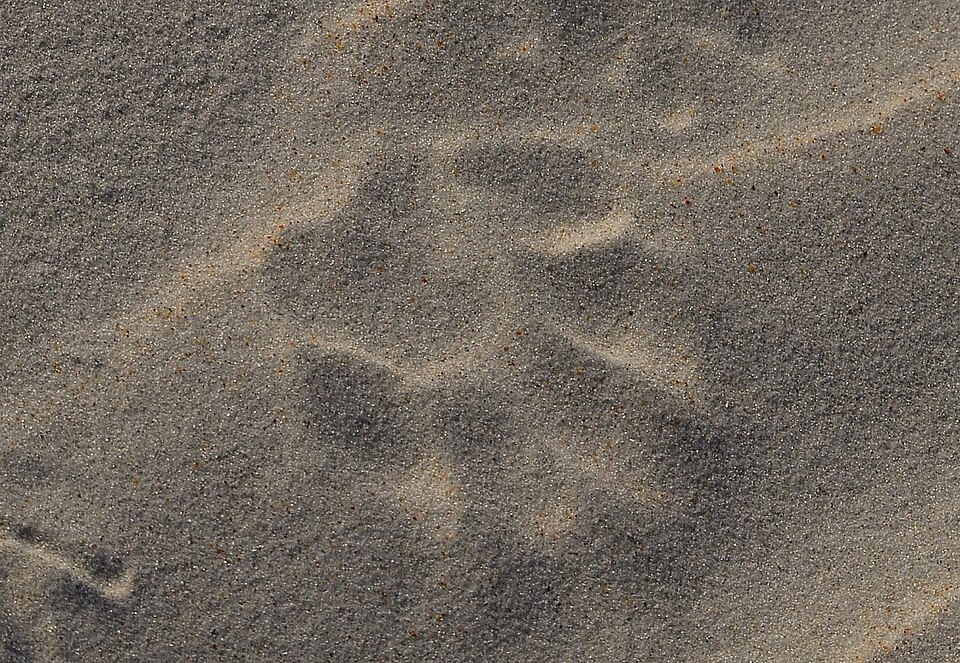
Bobcat tracks are roughly 1.5 to 2.5 inches in diameter. (Image source:“Bobcat Track” by Andrea Westmorelandlicensed under CC BY-SA 2.0, via Wikimedia Commons)

Bobcat tracks stand out with their distinctly rounded, compact shape, a hallmark of feline footprints.
Unlike coyotes, bobcats have retractable claws that rarely show in their tracks, leaving clean circular impressions. Four toe pads sit in a slight arc around the heel pad, with a C-shaped negative space between them that helps confirm identification.
Size Range: 1.5 to 2.5 Inches in Diameter
Bobcat tracks typically measure 1.5–2.5 inches in diameter, making them noticeably smaller than adult coyote prints. Front paws leave slightly larger impressions than hind paws, though the difference is subtle.
This compact size reflects the bobcat’s medium build: it is larger than a housecat but much smaller than a mountain lion.
Heel Pad with Two Front Lobes & Three Rear Lobes
The bobcat’s heel pad is its most distinctive feature: two lobes at the front edge and three at the rear, forming a bold, blotched letter M.
This pattern is clearly visible in soft mud or fresh snow and distinguishes bobcat tracks from those of similarly sized mammals. Even when other parts of the print are smudged, a clear heel pad impression can confirm you’re dealing with a bobcat.
Direct-Register Walking Pattern
Bobcats use a stealthy walking technique called “direct register,” in which their hind feet land almost perfectly within their front footprints. This creates a nearly single line of tracks rather than the paired pattern left by many other animals.
The step length typically measures 6–14 inches, reflecting the measured, cautious pace of an ambush predator moving through its territory.
Coyote Tracks: Elongated Pads with Visible Claws
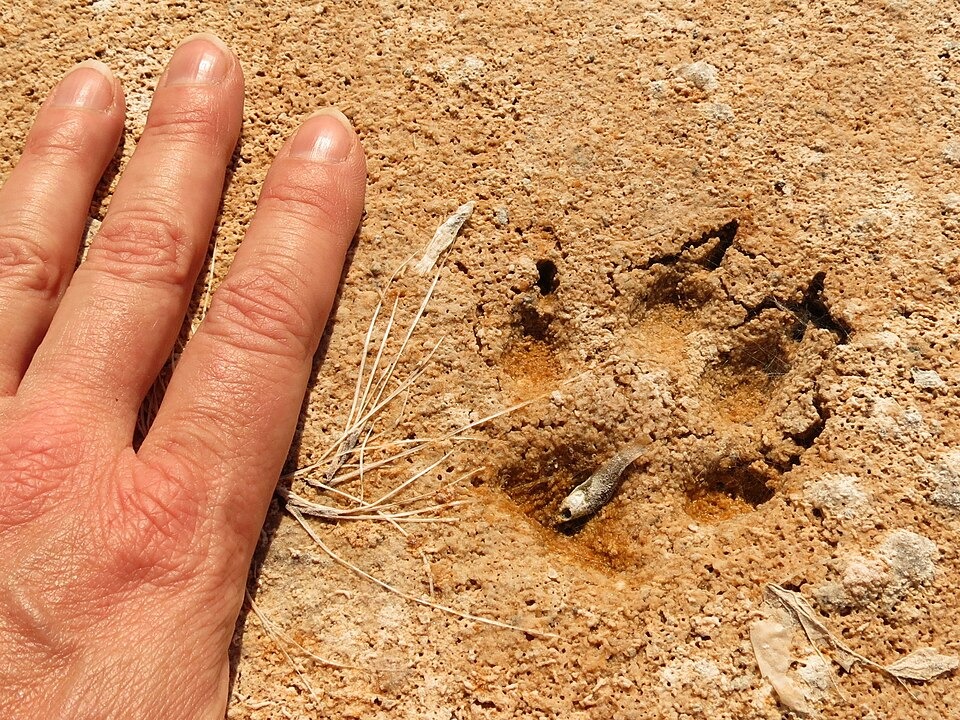
Coyote tracks have one front lobe and two rear lobes on the heel pad. (Image source:“Cayote Tracks” by Katja Schulzlicensed under CC BY-SA 2.0, via Wikimedia Commons)

Coyote tracks are unmistakably canine: oval, elongated, and marked by visible claws. Unlike bobcats, coyotes can’t retract their claws, so claw marks almost always show.
The two middle toes extend forward, giving the track a pointed look that’s nothing like the rounded arc of a bobcat print.
Size Range: 2.5 to 3.5 Inches Long
Coyote tracks typically measure 2.5–3.5 inches in length, making them notably more elongated than bobcat prints. Front paw prints are usually larger than hind prints, with the front paws measuring closer to the upper end of this range.
The width is generally about 2 inches, creating the characteristic oval shape that distinguishes coyote tracks from circular bobcat impressions.
Single Front Lobe and Two Rear Lobes on Heel Pad
Look at the heel pad: coyotes have one front lobe and two rear lobes, forming a shape often compared to a Volkswagen Beetle from above. This differs starkly from the bobcat’s M-shaped pad, making it a reliable identifier even when the rest of the track is unclear.
Trotting Gait with More Spaced Out Tracks
Coyotes move with a distinctive trotting gait, leaving tracks in a diagonal pattern rather than the bobcat’s straight-line trail. A typical trotting step measures 15–22 inches, much more spread out than bobcat prints. That wider spacing is a telltale sign you’re dealing with a coyote.
Bobcat vs. Coyote Tracks: Comparison Table
| Feature | Bobcat Tracks | Coyote Tracks |
| Size | 1.5–2.5 inches in diameter | 2.5–3.5 inches long |
| Shape | Round/circular | Oval/elongated |
| Claw marks | Absent (retractable claws) | Prominent (non-retractable) |
| Heel pad | M-shaped (2 front lobes, 3 rear lobes) | VW Beetle-shaped (1 front lobe, 2 rear lobes) |
| Gait pattern | Direct-register walking | Trotting with diagonal pairs |
| Typical habitat | Forests, rocky areas | Open terrain, fields |
What to Do if You Spot Bobcat or Coyote Tracks in Your Lawn
Take these immediate steps to protect your property:
- Secure food sources: Bring pet food indoors and use tight-fitting lids on garbage cans.
- Clean your yard: Remove fallen fruit and bird seed.
- Protect your pets: Keep small animals supervised during dawn and dusk hours.
- Add deterrents: Install motion-activated lights or sprinklers.
These simple steps can reduce your property’s appeal, but they won’t address the root cause. A wildlife control expert can identify entry points, assess risk levels, and implement long-term solutions tailored to your property.
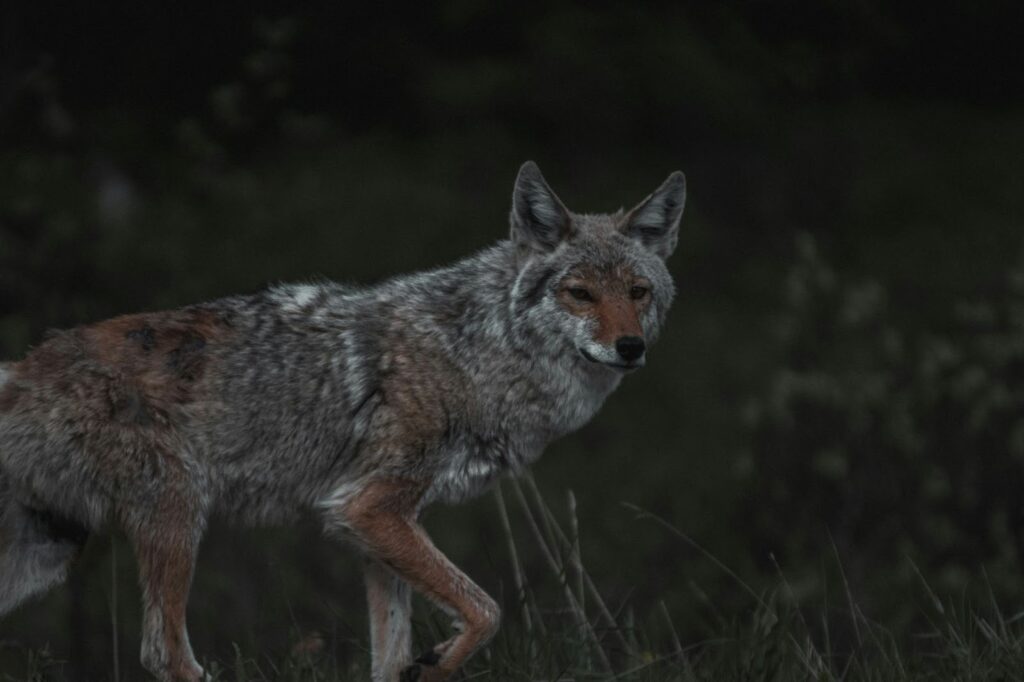
If you spot predator tracks, remove attractants, secure your yard, supervise small pets, and use motion-activated deterrents to prevent repeat visits.
How Connor’s Pest Pros Can Help
Finding bobcat or coyote tracks near your home isn’t something to ignore. These predators don’t show up by accident; something on your property is attracting them. Without professional intervention, you risk repeated visits that could endanger your pets, children, or even your sense of security in your own yard.
At Connor’s Pest Pros, we’ve earned our reputation as Northern Virginia and Maryland’s trusted wildlife control experts through results. With 415+ five-star reviews, Angi Super Service Award recognition, and membership in the National Pest Management Association, our family-owned business delivers same-day or next-day service backed by a 100% satisfaction guarantee.
Our trained technicians conduct thorough property inspections to identify exactly what’s attracting wildlife, then implement humane exclusion strategies and habitat modifications tailored to your specific situation. We don’t just chase animals away; we eliminate the reasons they came in the first place, with free re-treatments until you’re completely satisfied.
Don’t wait for a predator to threaten your family or pets. Contact us today for a free assessment and take back control of your property with solutions that actually work.
Frequently Asked Questions (FAQs)
What do coyote tracks in snow look like?
Coyote tracks in snow appear as clear oval impressions with four toe pads and prominent claw marks extending beyond each toe. The heel pad shows a distinctive one-lobe front and two-lobe rear pattern. You’ll also notice a diagonal trotting pattern with 15–22 inches between track sets.
How big are bobcat footprints?
Bobcat footprints typically measure 1.5–2.5 inches in diameter, creating compact, rounded impressions. Front paw prints are slightly larger than hind paw prints. For comparison, domestic cat tracks measure only 1–1.75 inches, while mountain lion tracks are significantly larger at 3–5 inches.
Do bobcats come close to houses?
Bobcats occasionally venture near houses, especially in areas that border natural habitats. They’re typically attracted to food sources such as rodents or rabbits rather than to human dwellings. Their presence often goes unnoticed since they’re secretive and most active during dawn and dusk.
What does it mean when a coyote hangs around your house?
A coyote lingering near your home is typically attracted by accessible food, unsecured garbage, outdoor pet food, fallen fruit, or abundant small prey. Persistent visits suggest the coyote has found reliable nutrition on your property. Remove attractants immediately and use hazing techniques, such as loud noises, to discourage repeat visits.
How can Connor’s Pest Pros help protect my home against coyotes and bobcats?
Connor’s Pest Pros protects your property from unwanted wildlife through humane deterrence and habitat modification. Trained technicians identify attractants, recommend exclusion measures, and implement customized strategies to keep coyotes, bobcats, and other wild predators at a safe distance.
*Image Disclaimer: Some images used in this blog post are sourced from third-party websites and remain the property of their respective owners unless otherwise stated. We do not claim ownership of these images and use them for illustrative purposes only.