

Key Takeaways
- Mouse droppings measure 3–6mm with pointed ends, while termite droppings (frass) are much smaller at roughly 1mm with six distinct concave sides.
- Mouse droppings scatter along baseboards and inside cabinets, while termite frass appears in small piles near wood kick-out holes.
- Fresh mouse droppings are soft, dark, and shiny, while termite frass stays hard and granular with a color range from light beige to black.
- Each pest carries different risks. Mice pose disease and contamination concerns, while termites silently cause structural damage that can go undetected for months.
- At Connor’s Pest Pros, we identify which pest you’re dealing with and deliver same-day treatment across the DC metro area and Greensboro, NC.
What Those Tiny Pellets Near Your Wood Actually Are
Mouse droppings are dark, tapered at both ends, and typically scattered in trails along the routes mice follow every night. Termite droppings, known as frass, are tiny fecal pellets that drywood termites push out of the wood they’re actively feeding on through small kick-out holes. Rather than scattering, frass accumulates in neat piles directly below those holes.
The two also indicate very different threats. Mice are prolific breeders that can double their population every three weeks, and their droppings pose disease risks tied to Hantavirus, LCMV (lymphocytic choriomeningitis virus), and Salmonella. Termites, by comparison, silently hollow out the wood inside your home for months or years before any outward damage becomes visible.
Connor’s Pest Pros offers same-day inspections and free estimates across the DC metro area and Greensboro, NC, so if you’re not sure what you’ve found, a licensed technician can confirm the pest and start the right treatment the same day.
Connor’s Pest Pros: Trusted, Family-Owned Pest Control
4.9★ Google Rating | 100% Satisfaction Guarantee

Protect Your Home, Pest-Free:
Get customized, ongoing pest control that adjusts with the seasons, covering everything from ants and spiders to termites, rodents, and bed bugs. Same-day or next-day visits mean fast relief.
What Sets Us Apart:
✓ 950+ 5-star reviews on Google
✓ Family-owned, D.C. metro area
✓ Member of the NPMA
✓ Angi Super Service Award Winner (2024)
✓ 100% Satisfaction Guarantee
Don’t let pests take over your home. Act now.
Request Your Free Estimate →What Mouse Droppings Look Like
Mouse droppings are dark brown to black pellets that resemble a grain of rice. They measure between 3 and 6mm in length, with their spindle-like shape being the clearest visual marker.
Fresh mouse droppings are soft, dark, and slightly shiny. As they age, they dry out, fade to a lighter grayish-brown, and become brittle and crumbly. If droppings crumble when disturbed, the activity may have already stopped. Soft, dark pellets mean the mouse is likely still present.
You’ll typically find mouse droppings scattered along baseboards, wall edges, inside kitchen cabinets and pantry shelves near food sources.
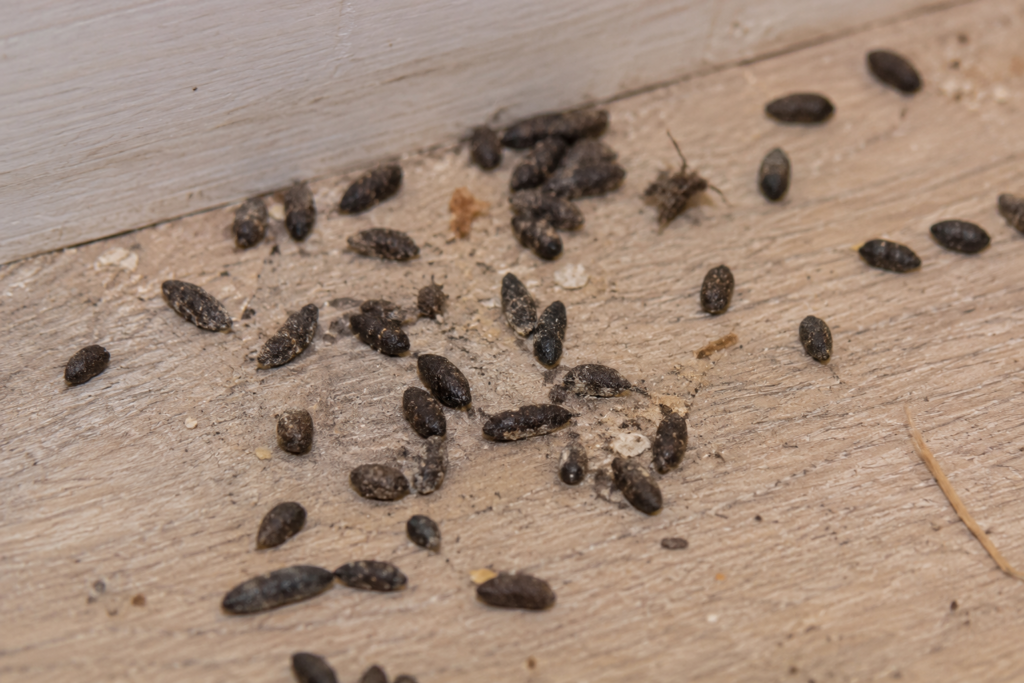
Mice produce between 50 and 75 droppings per day, so infestations tend to leave highly visible trails rather than isolated pellets.
What Termite Droppings Look Like
Termite droppings look nothing like mouse droppings once you know what to look for. Drywood termite frass consists of tiny oval pellets approximately 0.9 to 1mm long, which is roughly one-sixth the size of a mouse dropping. That size difference alone rules out a lot of confusion.
The defining physical feature of termite frass is its six concave sides with rounded ends. Under a magnifying glass, each pellet looks almost like a tiny barrel or a football with six indentations running along its length. The color ranges from light beige and tan all the way to dark brown or black, depending on what species of wood the termites have been consuming.
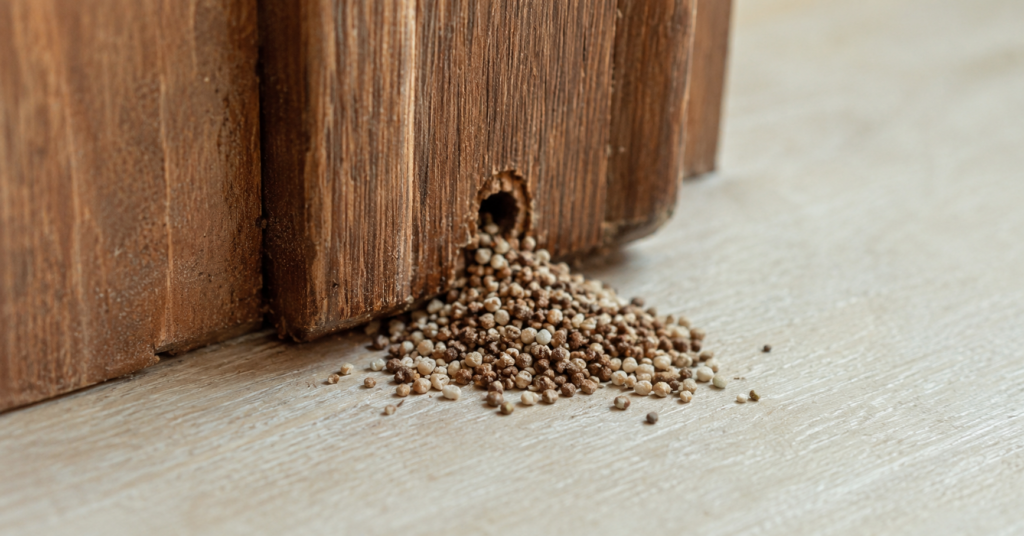
Unlike mouse droppings that scatter in trails, termite frass tends to accumulate in small, neat piles or mounds directly below the kick-out holes that drywood termites push their waste through.
Mouse Poop vs Termite Droppings: How to Tell the Difference
- Look at the Size: Mouse droppings are 3 to 6mm long, large enough to see clearly without any magnification. Termite frass sits at roughly 0.9 to 1mm, which means you could line up five or six termite pellets end-to-end and still not match the length of a single mouse dropping.
- Look at the Shape: Mouse droppings taper to a distinct point at both ends, giving them that classic spindle or rice-grain silhouette. With termite frass, each pellet is oval with six concave indentations running along its sides and rounded ends. If you can get a magnifying glass on the pellets and count those six sides, you’re looking at drywood termite frass with near certainty.
- Check the Location: Mouse droppings appear in trails because mice follow the same routes repeatedly. Check along wall edges, inside cabinets, behind appliances, and near any food storage. Drywood termites push their waste out of the wood through tiny kick-out holes, so frass almost always appears in a small concentrated pile directly beneath these exit points. Common discovery spots include windowsills, door frames, baseboards, wooden furniture, and attic beams.
When to Call a Professional
If you’ve identified the droppings but aren’t completely certain which pest you’re dealing with, don’t wait. Both mice and drywood termites cause damage that compounds quickly. A mouse population doubles in as little as three weeks. A termite colony can silently consume structural wood for months without a single visible sign beyond the frass pile you’re staring at right now.
Call a pest professional immediately if you notice any of these alongside the droppings:
- Gnaw marks on food packaging, wood trim, or wiring insulation (mouse).
- Hollow-sounding wood when you knock on baseboards or beams (termite).
- Scratching or scurrying sounds inside walls at night (mouse).
- Discarded wings near windowsills or door frames (termite swarmers).
- Grease marks or dark smudges along baseboards (mouse).
- Blistering or bubbling paint on wood surfaces (termite).
At Connor’s Pest Pros, we can help you confirm which pest is behind the droppings and start treatment before the problem grows.

If you’ve noticed mouse poop or termite droppings, call a professional exterminator.
Mouse Poop vs Termite Droppings: Comparison Table
| Feature | Mouse Droppings | Termite Droppings (Frass) |
| Size | 3–6mm | 0.9–1mm |
| Shape | Spindle-shaped, tapered at both ends | Oval with six concave sides, rounded ends |
| Color | Dark brown to black; fades gray with age | Light beige to dark brown or black |
| Texture | Soft when fresh, brittle when old | Hard, granular, sand-like |
| Pattern | Scattered trails along travel routes | Neat piles beneath kick-out holes |
| Location | Cabinets, baseboards, behind appliances | Windowsills, door frames, wood surfaces |
| Smell | Strong ammonia-like odor | Little to no odor |
| Danger | Disease contamination risk | Structural wood damage |
Why Connor’s Pest Pros Is Your Trusted Pest Control Service
Telling mouse droppings apart from termite frass comes down to size, shape, and location. Once you know what to look for, most homeowners can make an accurate first identification in under a minute. What matters more is what you do next. Both pests are aggressive multipliers, and every day of delay adds to the damage or the risk they’re already creating.
At Connor’s Pest Pros, our team draws on years of hands-on experience across the DC metro area, Northern Virginia, Maryland, and Greensboro, NC, and we handle both rodent and termite infestations with the specialized approach each pest requires. Our treatments are backed by a 100% Satisfaction Guarantee, so if pests return between visits, we’ll re-treat your home at no extra cost. Request a free estimate to begin.
Frequently Asked Questions (FAQs)
How do you identify mouse droppings?
Mouse droppings are dark brown to black, 3 to 6mm long, and shaped like a grain of rice with pointed tips at both ends. Fresh droppings are soft and shiny. Older droppings dry out and turn grayish and crumbly. You’ll typically find them scattered in trails along baseboards, inside cabinets, or behind appliances.
What can be mistaken for mouse droppings?
Termite frass, cockroach droppings, and rat droppings are the most common look-alikes. Cockroach droppings are smaller with ridged sides. Rat droppings are larger, with blunt ends rather than tapered ones. Termite frass is significantly smaller and has a distinct six-sided shape that sets it apart from rodent waste when examined closely.
What is the difference between termite droppings and mouse droppings?
The key differences are size, shape, and location. Mouse droppings are 3–6mm in length with tapered ends and are scattered in trails. Termite frass is roughly 1mm long, with six concave sides, and accumulates in neat piles beneath wood kick-out holes. Termite frass has little to no odor, while mouse droppings carry a distinct ammonia smell.
How do you identify termite droppings?
Termite droppings are tiny oval pellets about 1mm long with six concave sides and rounded ends. They range from beige to dark brown and often resemble fine sand, coffee grounds, or sawdust. Look for small neat piles near wooden surfaces, windowsills, or door frames — especially below small holes in the wood where termites push out their waste.
Does Connor’s Pest Pros offer same-day service?
Yes. At Connor’s Pest Pros, we offer same-day and next-day service across the DC metro area, Northern Virginia, Maryland, and Greensboro, NC. Because both rodent and termite infestations spread quickly, a fast response matters, so we prioritize sending a licensed technician to your home as soon as possible after your call.
*Price estimates reflect current market costs and may vary based on your specific situation. For a personalized quote tailored to your needs, contact us directly or request your FREE estimate today!