
Key Takeaways
- Wasp, bee, and hornet nests look completely different, and knowing which one you’re dealing with is the first step to staying safe and handling it correctly.
- Hornet nests are enclosed with a primary entrance at the bottom, while paper wasp nests are open-faced and umbrella-shaped, and bee nests are often hidden inside walls, trees, or underground.
- Hornets are especially aggressive defenders, and disturbing a nest without the right approach can result in painful, potentially serious stings.
- If you’re dealing with wasp, bee, or hornet nests on your property, Connor’s Pest Pros can handle the removal safely and effectively.
Wasp, Bee, or Hornet: Here’s How to Identify the Nest
The nest tells the story. Once you know what to look for, identifying whether you’re dealing with a wasp, bee, or hornet becomes a lot less intimidating.
Each of these stinging insects builds its home in a very specific way, using different materials, locations, and structural designs. A paper wasp nest looks nothing like a hornet nest, and neither looks anything like a honey bee hive.
Getting this identification right matters because the species determines the risk level, the behavior you can expect, and the safest way to deal with the problem.
|
Connor’s Pest Pros: Family-Owned Pest Control Experts Choose Your Pest Protection Solution:
Customer Praise:
★★★★★ “Quick to answer my call and available same-day… I recommend them to anyone looking for pest control in NOVA.” – Jacquelyn L.
Why Choose Connor’s Pest Pros:
|
How Do You Identify a Wasp Nest?
Wasps are a broad category that includes paper wasps, yellowjackets, mud daubers, and more. Because of this, wasp nests come in several different forms depending on the species involved.
Paper Wasp Nests: Open Architecture and Umbrella Shape
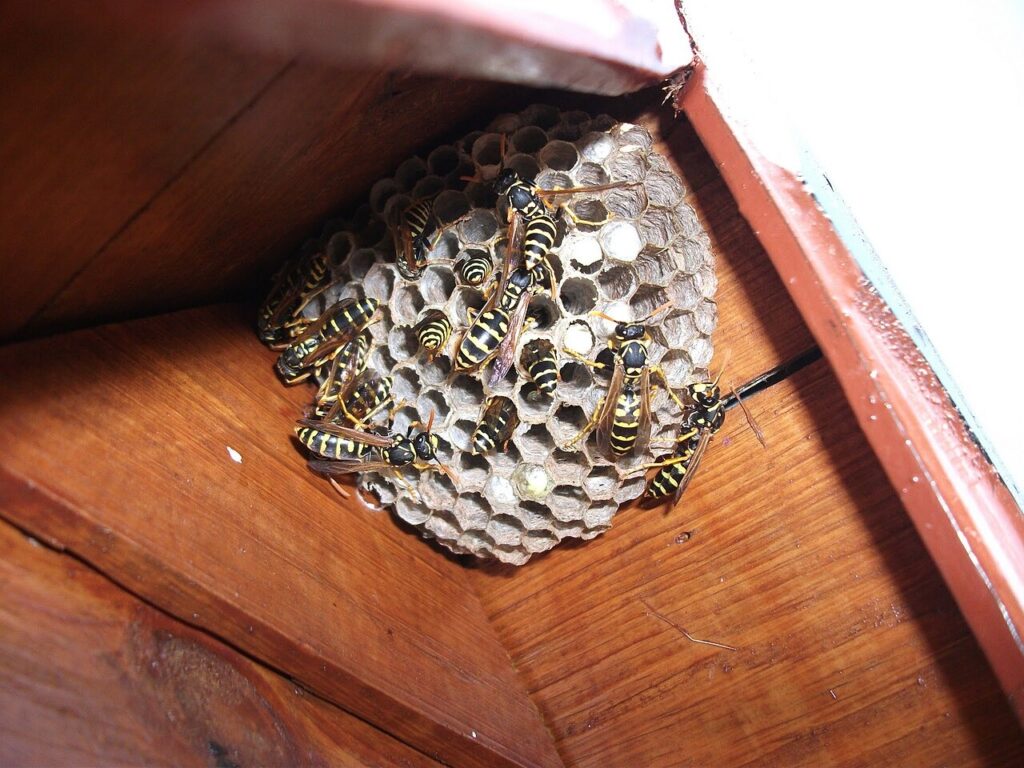
Paper wasp nests typically hang like an inverted umbrella(Image source:“European paper wasp (nest)” by Tdolphin~plwikilicensed under CC BY-SA 4.0, via Wikimedia Commons)

Paper wasp nests are built from chewed wood fibers and saliva, which dry into a papery gray material. The result is a small, open-faced comb that hangs like an upside-down umbrella, with hexagonal cells fully visible from below and no outer covering. You’ll commonly find these attached to tree limbs, porch ceilings, roof eaves, and fence posts.
Yellowjacket Nests: Hidden Underground or in Wall Voids
Yellowjackets are trickier to locate because they prefer hidden, enclosed spaces. They frequently build underground, taking over abandoned rodent burrows or natural soil cavities. They’ll also nest inside wall voids, attics, and hollow spaces within structures.
The nest itself is made from the same paper-like chewed fiber material as paper wasps, but it’s enclosed and much harder to spot. Often, the only visible sign is a steady stream of wasps entering and exiting a small hole in the ground or in a wall.
Mud Dauber Nests: Mud Tubes Built by Solitary Wasps
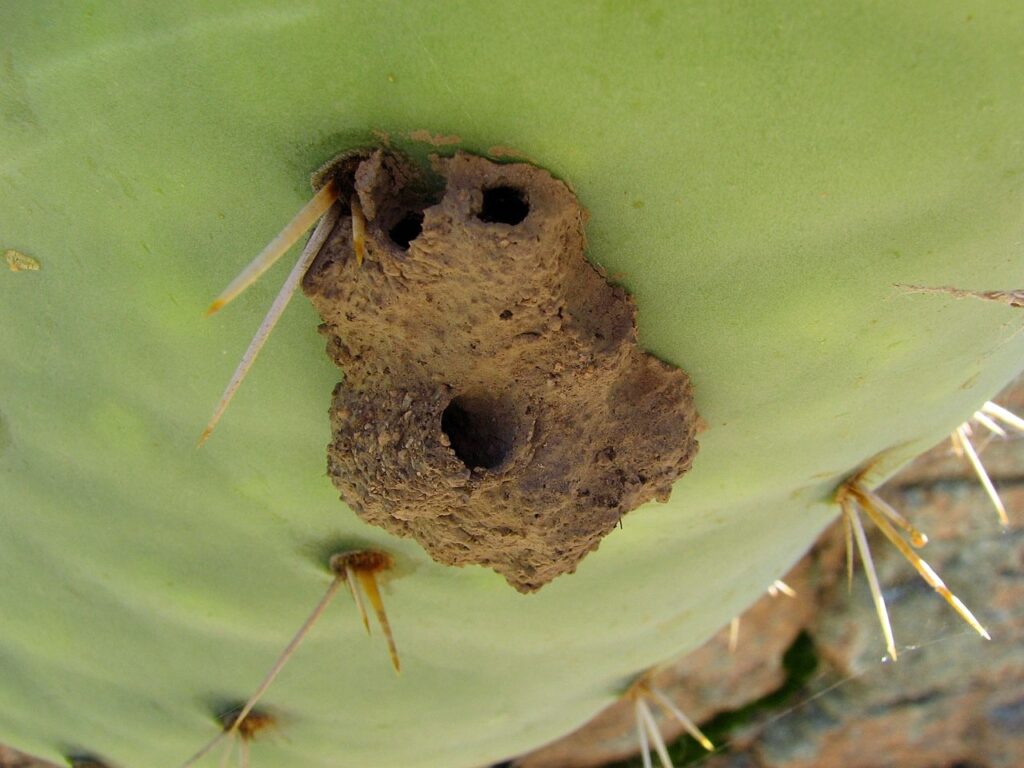
Mud dauber wasp nests are made of wet mud (Image source:“Mud Dauber Nest” by Katja Schulzlicensed under CC BY-SA 2.0, via Wikimedia Commons)

Mud dauber wasps build using wet mud, though nest shape varies by species. Their nests are usually found on walls, under eaves, inside garages, or in sheltered outdoor areas. While mud daubers are far less aggressive than other wasp species, their nests are distinctive and worth identifying correctly.
Hornet Nest Identification: Size, Shape, and Location
Hornets are technically a type of wasp. Specifically, they are the largest of the social wasps. Their nests reflect that size.
While a paper wasp nest might be a few inches across, a mature hornet nest can reach the size of a basketball or larger by late summer.
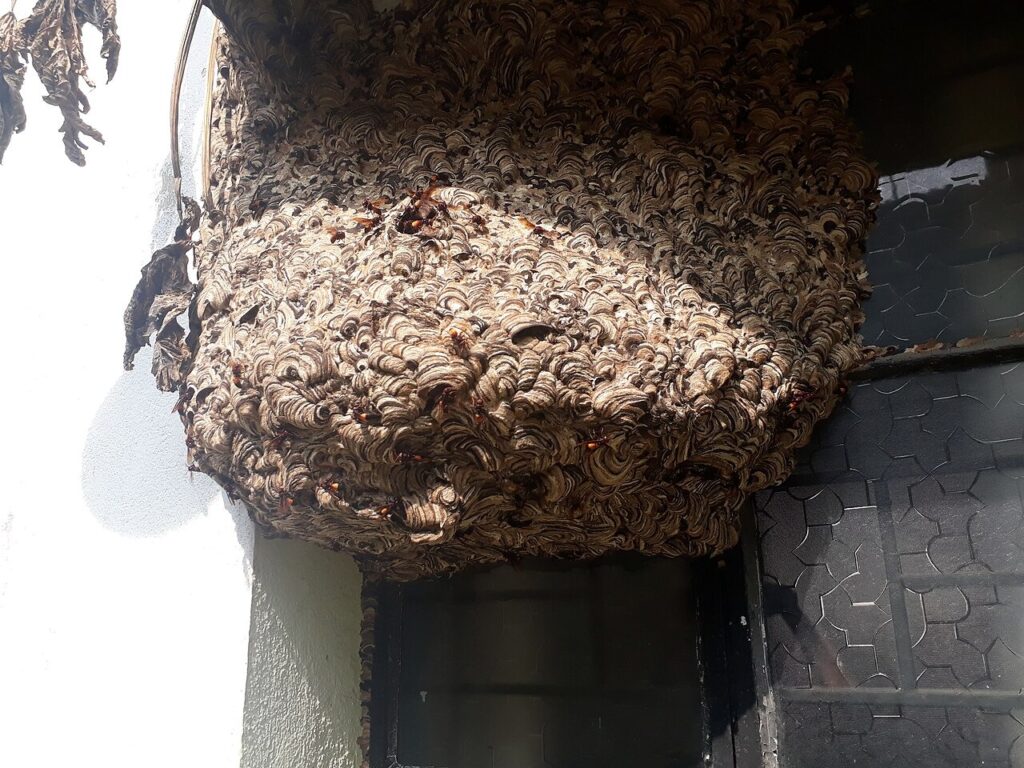
Hornet nests are usually enclosed, with their primary entrance positioned at the bottom. (Image source:“The Hornet Nest” by Pinakpanilicensed under CC BY-SA 4.0, via Wikimedia Commons)

Closed Architecture: The Envelope and Single Bottom Opening
What separates a hornet nest from a paper wasp nest most immediately is its outer shell. Hornet nests are built with a complete envelope. It is enclosed by a layered outer covering made from the same chewed wood fiber and saliva as other wasp nests, but formed into a sealed, rounded structure.
The primary entrance is a single opening at the bottom of the nest, though some nests also have secondary openings near the top. This design protects the colony from weather and predators, and it also makes hornets significantly harder to treat without professional pest control equipment.
Where Hornets Build: Trees, Eaves, Attics, and Wall Voids
Hornet nests are commonly found hanging from tree branches, tucked into dense shrubs, or suspended from the overhanging eaves of a house. When they move indoors (which happens more often than homeowners expect), they set up inside attics, wall voids, and even behind siding panels.
Once a hornet colony establishes itself inside a structure, removal becomes significantly more complex. A nest inside a wall void requires locating the colony, treating it correctly, and then sealing the entry points to prevent future access. All of this should be done without triggering a defensive response from thousands of insects.
How Do Bees Build Their Nests?
Bees build with wax, not chewed wood fiber, which gives their nests a fundamentally different structure than anything a wasp or hornet produces.
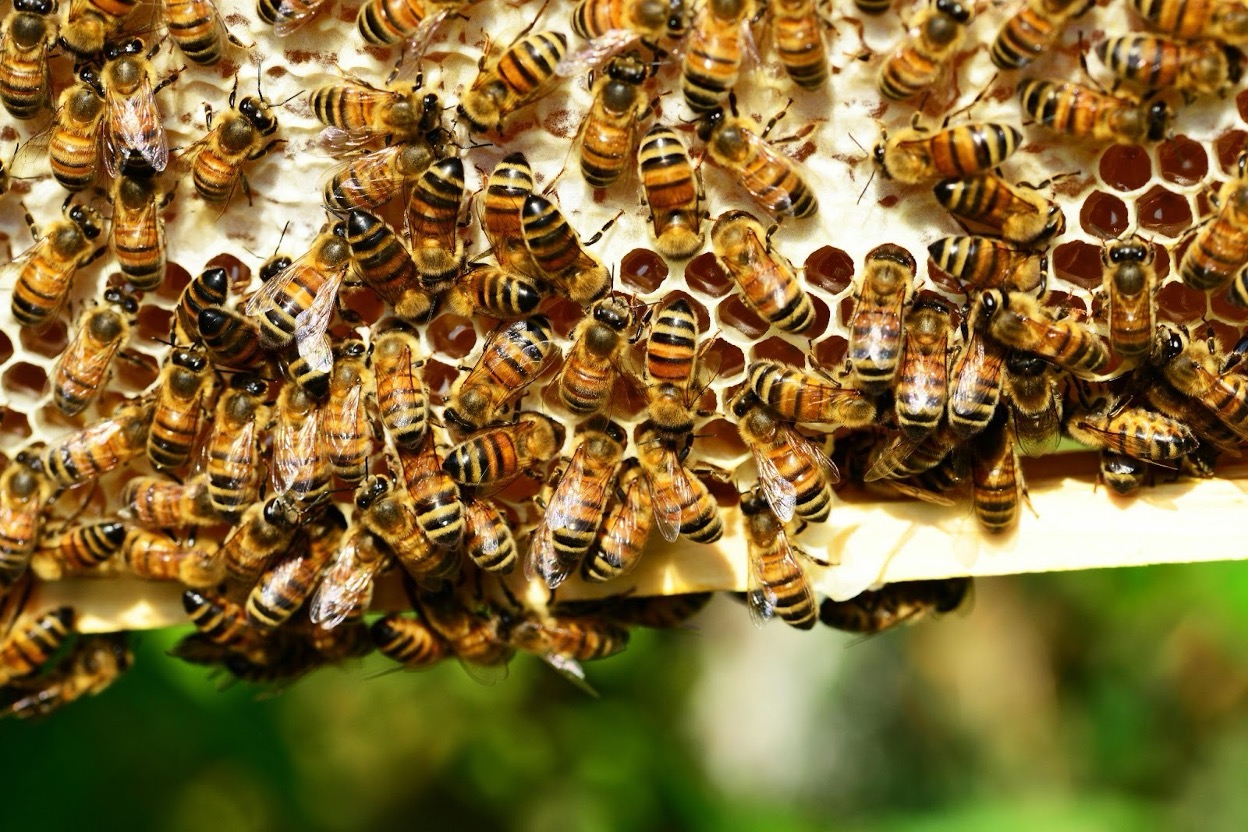
The classic honeycomb structure with its perfect hexagonal wax cells is the hallmark of a bee nest, and it’s immediately distinctive once you know what you’re looking at. Beyond the material difference, bees also vary dramatically by species in terms of where they choose to nest and how large their colonies grow.
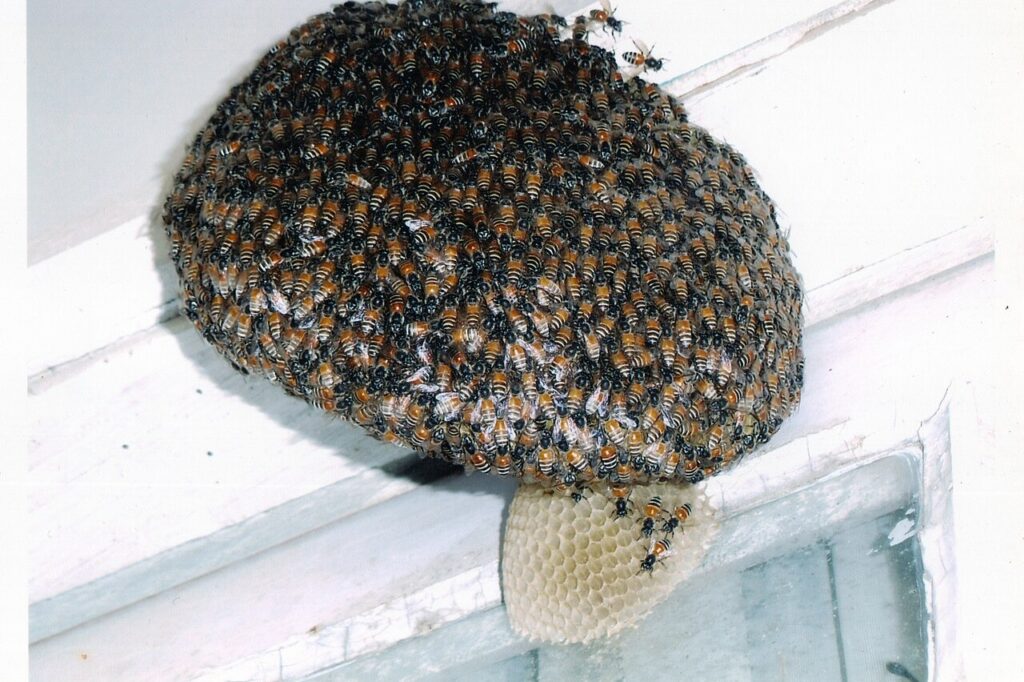
Hives are typically established on crawlspaces, attics, or walls (Image source:“Honey Bee Nest” by GerogelsMedialicensed under CC BY-SA 4.0, via Wikimedia Commons)

Where Honey Bees Nest and Where They Don’t
In nature, honey bees strongly prefer to nest in hollow trees or logs, enclosed spaces that offer insulation and protection. When they gain access to human structures, they will establish hives in walls, attics, and crawlspaces.
European honey bees do not nest in the ground. If you’re in the northern U.S. and seeing bees emerging from a hole in your lawn, you are almost certainly not dealing with honey bees, though Africanized honey bees in southern states can and do nest in the ground.
Wasp vs Bee vs Hornet Nest: Comparison Table
| Insect | Nest Material | Nest Shape | Architecture | Common Locations | Colony Size |
| Paper Wasp | Chewed wood fiber | Umbrella / open comb | Open (cells visible) | Eaves, tree limbs, porches | Small (a few dozen) |
| Yellowjacket | Chewed wood fiber | Enclosed, layered | Closed (hidden entry) | Underground, wall voids, attics | Medium (hundreds to thousands) |
| Mud Dauber | Mud | Cylindrical tubes | Sealed individual cells | Walls, garages, under eaves | Solitary (no colony) |
| Hornet | Chewed wood fiber | Large, rounded envelope | Closed (primary bottom opening; secondary top openings possible) | Trees, eaves, attics, wall voids | Up to 700 workers (bald-faced hornets); up to 1,000 workers (European hornets) |
| Honey Bee | Wax comb | Layered hexagonal comb | Open comb inside enclosed cavity | Hollow trees, wall voids, attics | Up to 80,000 |
How to Remove Wasp, Bee, and Hornet Nests
Yellowjacket nests, hornet nests, and any bee colony inside a wall or attic should not be treated as DIY projects. Hornets (with colonies of up to 700 workers for bald-faced hornets and up to 1,000 for European hornets) will aggressively defend their nest, and disturbing a yellowjacket colony underground can trigger hundreds of stings before you even realize what’s happening.
The best option is to go for professional pest control services, especially when dealing with yellowjacket nests, bee colonies, and hornet nests. This way, you can ensure that the root of the problem is addressed and that you and your family will be kept safe against these pests.
Call Connor’s Pest Pros for Professional Pest Control Service
If you’ve identified a wasp, hornet, or bee nest on your property and would like to opt for professional pest control services, we at Connor’s Pest Pros provide expert stinging insect removal services that protect your home and your family. We handle everything from hidden yellowjacket colonies to full honey bee hive extractions from wall voids
We have the equipment, training, and species-specific knowledge to locate the nest, treat it correctly, and seal entry points so the problem doesn’t come back next season.
If the colony is hanging from a tree branch, buried under your lawn, or hidden inside a wall cavity, the approach needs to match the pest, and that precision is what separates a permanent fix from a temporary patch.
Contact us today for a free quote!
Frequently Asked Questions (FAQs)
What is the easiest way to tell a wasp nest from a bee nest?
The easiest way to tell a wasp nest from a bee nest is to look at the nest material and structure. Wasp nests (including paper wasp and hornet nests) are made from a gray papery material created from chewed wood fiber. Bee nests are built from wax comb and are typically hidden inside an enclosed cavity like a wall or hollow tree rather than hanging in the open.
Are hornet nests more dangerous than wasp nests?
Yes. Hornets are significantly more aggressive defenders of their colony. They will pursue a perceived threat further from the nest, and they can sting multiple times without dying.
Yellowjacket wasp nests hidden underground or inside walls can also be extremely dangerous when disturbed accidentally, because the confined space concentrates the defensive response.
Can I remove a wasp or hornet nest myself, or should I call a professional?
For anything large, hidden, or involving hornets, yellowjackets inside a structure, or honey bees, professional removal is strongly recommended. The risk of a severe defensive response, incomplete treatment leaving a surviving colony, or secondary damage from untreated comb and honey inside a wall is too significant to manage without the right equipment and species-specific approach.
Can Connor’s Pest Pros remove wasp, bee, or hornet nests from my house?
Yes. Connor’s Pest Pros handles the full range of stinging insect infestations, including paper wasps, yellowjackets, hornets, mud daubers, honey bees, and ground-dwelling bees. Treatment approaches are species-specific.