Key Takeaways
- Bird droppings are typically white and chalky, with a darker center, and are often found scattered on outdoor surfaces such as ledges, vehicles, or porches. Bat droppings (guano) are dark brown to black, sausage-shaped, and tend to crumble easily when touched.
- Texture and content reveal the clearest differences. Bat guano contains visible insect parts (wings, legs, exoskeleton fragments) since bats are insectivores, and it crumbles into a fine powder when disturbed. Bird droppings have a smoother, paste-like consistency, free of insect remains, and harden into a sticky residue rather than crumbling.
- Safe cleanup requires the right tools and approach. Wear an N95 respirator (or better), gloves, eye protection, and disposable clothing. Use a HEPA-filter vacuum, double-bag waste, and thoroughly disinfect the surrounding area. For large or long-standing infestations, call professional pest control services, such as Connor’s Pest Pros.
- For homeowners across Northern Virginia, Maryland, and the wider D.C. metro area, Connor’s Pest Pros can handle the entire process, including humane removal of birds or bats, full cleanup, and disinfection. With same-day service and a 100% satisfaction guarantee, Connor’s Pest Pros is the team to call when you want the problem solved end-to-end.
Bird Poop vs Bat Poop: The Key Differences at a Glance
At a glance, bird and bat droppings can look nearly identical: dark, small, and clustered in the same spots. But once you know what to look for, the differences become obvious. The key identifiers come down to texture, what’s inside the dropping, and where exactly it’s located.
Bird droppings tend to have a two-toned appearance: a dark center surrounded by a white or cream-colored outer ring. That white portion is uric acid, which is how birds excrete waste from their kidneys. Bat droppings, on the other hand, are uniformly dark brown or black with no white component at all.
Whether it’s birds roosting in your entryway or bats colonizing your attic, the droppings they leave behind are a genuine health hazard. Always use protective gear when cleaning up light droppings, but when you’re dealing with an infestation, leave it to expert pest control service providers, such as Connor’s Pest Pros.
|
Connor’s Pest Pros: Family-Owned Pest Control Experts Choose Your Pest Protection Solution:
Customer Praise:
★★★★★ “Quick to answer my call and available same-day… I recommend them to anyone looking for pest control in NOVA.” – Jacquelyn L.
Why Choose Connor’s Pest Pros:
|
What Does Bird Poop Look Like?
Bird droppings are one of the most recognizable forms of animal waste once you understand their structure. They’re produced from a single exit point called the cloaca, which means urine and feces are expelled together, giving them a distinct two-toned look. The consistency varies depending on the bird’s diet, hydration, and species.
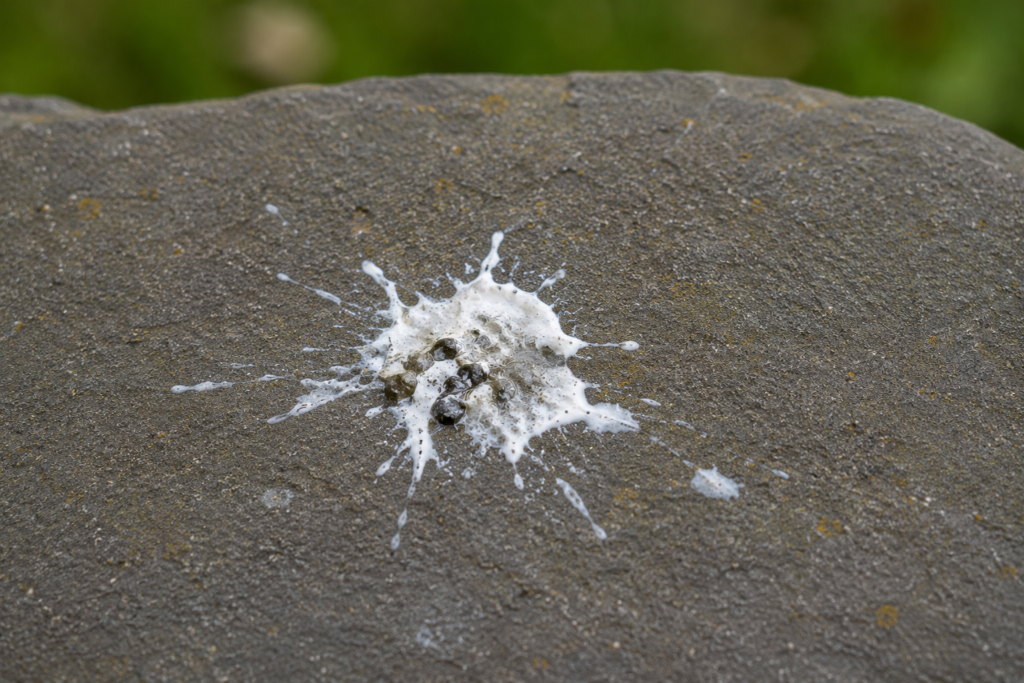
Bird poop usually appears like a glossy splatter.
Color & Texture
Fresh bird droppings are typically white, off-white, or cream-colored on the outside with a darker, greenish, or brownish center. The outer white layer is uric acid, which dries quickly and becomes chalky or powdery. Some droppings from fruit-eating birds may have purple or reddish tones depending on what they’ve been eating.
Size & Shape
Bird droppings vary enormously by species. Small songbirds produce tiny, splatter-shaped drops just a few millimeters across, while larger birds like pigeons or seagulls leave thick, pasty droppings that can be over an inch long. Shape tends to be irregular, and fresh droppings have a wet, glossy appearance that dulls as they dry.
Where You’ll Find It
Birds roost in open or semi-open areas, so their droppings tend to accumulate on horizontal surfaces below roosting spots. Common locations include:
- Building ledges and window sills.
- Entryways, awnings, and covered porches.
- Rooftops and gutters.
- Outdoor furniture and vehicles that are parked near trees.
- Air conditioning units on rooftops.
What Does Bat Poop Look Like?
Bat droppings, commonly called guano, are often mistaken for squirrel or rat droppings, but they have very specific characteristics that set them apart once you know what to look for.
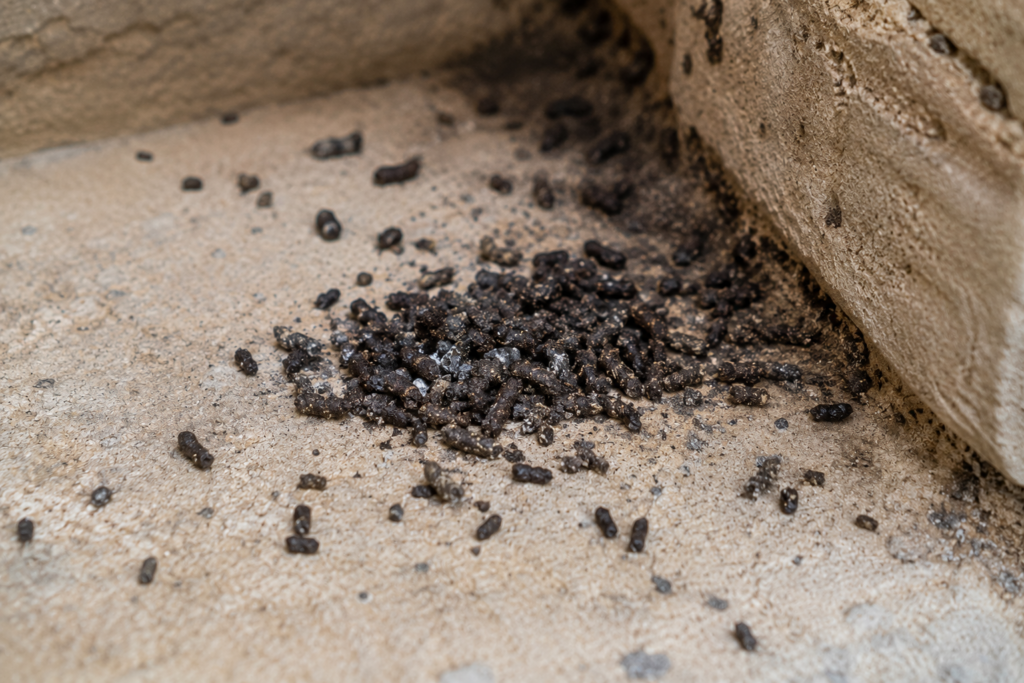
Bat droppings look similar to squirrel droppings and may appear slightly moist.
Color & Texture
Bat guano is uniformly dark brown to black, with no white portions. Fresh droppings have a slightly moist appearance, but dried guano becomes brittle and crumbles easily. Unlike bird droppings, bat guano has a distinct texture when broken apart. It disintegrates into a fine, dark dust rather than holding its shape.
Size & Shape
Individual bat droppings are small, elongated, and pellet-shaped, typically around 1/4 to 3/8 of an inch long. They’re often compared to mouse droppings in size, but bat droppings are slightly larger and more uniform in shape than mouse feces. Gray squirrel droppings are actually the most similar in size to bat guano, making size alone an unreliable identifier.
Bat droppings will immediately crumble into a fine dust if you pinch them between your fingers (while wearing gloves). Inside that dust, you’ll see tiny shiny fragments. These are the undigested chitin from insect exoskeletons, since bats are insectivores.
Where You’ll Find It
Bats roost in enclosed, dark spaces and return to the same location every night. This means guano accumulates in very specific, predictable spots:
- Directly below the attic roost points in concentrated piles.
- Near entry and exit points, gaps in rooflines, soffits, or fascia boards.
- Inside wall voids where bats squeeze through.
- On attic insulation beneath active roost sites.
Cleanup Tips for Safely Cleaning Up Bird & Bat Droppings
Cleanup protocol depends entirely on the scale of what you’re dealing with. A few droppings on a porch railing require basic precautions. However, a bat colony that’s been roosting in an attic for years is a biohazard remediation job that goes well beyond DIY territory.
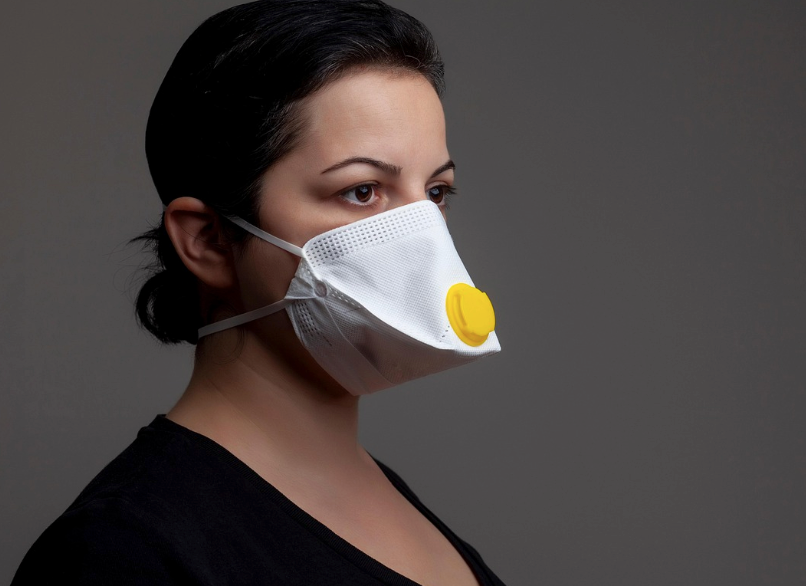
A properly fitted respirator protects you from inhaling harmful pathogens released when bird or bat droppings are disturbed.
Step-by-Step Cleanup for Small Areas
For minor accumulations on exterior surfaces, such as window sills, porch furniture, or small sections of the roofline, you can handle cleanup yourself as long as you’re properly protected. Thoroughly wet the droppings before any physical removal to prevent dust from becoming airborne.
- Put on all protective gear before approaching the area. Wear an N95 respirator (or better), disposable gloves, eye protection, disposable coveralls, and shoe covers.
- Lightly mist the droppings with water or a diluted disinfectant solution to thoroughly dampen them.
- Use a disposable scraper or paper towels to lift the softened material. Do not scrub dry.
- Place all material directly into a heavy-duty plastic bag, seal it immediately, then place that sealed bag inside a second heavy-duty garbage bag for larger amounts.
- Wipe the surface with a disinfectant appropriate for the material (see FAQ section below for product guidance).
- Remove and bag your gloves and any disposable clothing before re-entering the home.
- Wash hands and exposed skin thoroughly with soap and water.
- Dispose of the sealed dropping bag from Step 4 and the bagged PPE from Step 6 in your outdoor garbage bin. Do not place contaminated bags in an open recycling bin or compost.
When to Call a Professional
Call a professional any time the infestation has been ongoing long enough that droppings have soaked into building materials, insulation, or structural wood. At that point, the contamination extends well beyond what’s visible, and surface cleaning alone won’t eliminate the health risk. At Connor’s Pest Pros, our team is well-equipped to handle both the cleanup and the underlying infestation in a single coordinated response.
You should also call immediately if you discover bat droppings in a living space, not just an attic. Bats inside walls or living areas pose a direct risk of rabies exposure, changing the nature of the problem entirely. In those situations, the guano cleanup is secondary to safely removing the animals and assessing whether anyone in the home may have been exposed.
We offer same-day service for urgent wildlife situations, with humane bat removal, exclusion, and full home inspections to identify how the animals got in. Our professional remediation teams have the equipment, containment protocols, and disposal certifications to safely handle large-scale bird and bat waste.
We will also identify and seal entry points to prevent re-infestation, which is just as important as the cleanup itself, because droppings will return within weeks if the entry points remain open.
Bird Poop vs Bat Poop: Comparison Table
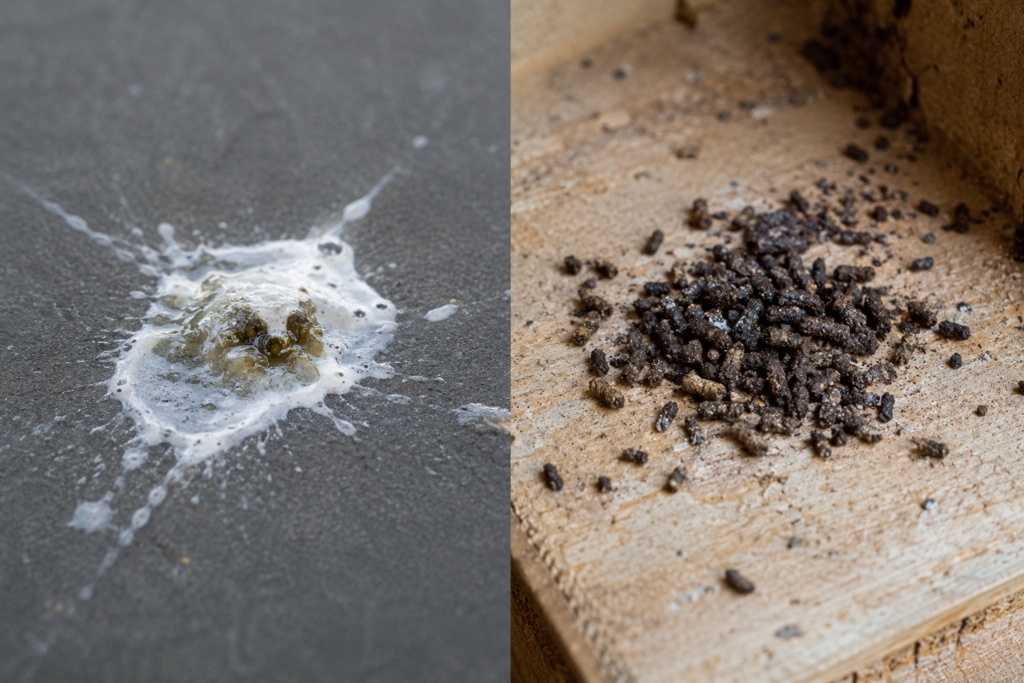
Bird poop often appears white, while bat poop is dark brown or black.
| Feature | Bird Droppings | Bat Droppings (Guano) |
| Color | White/cream outer ring, dark center | Uniformly dark brown or black |
| Shape | Irregular splat or streak | Small elongated pellet |
| Size | Varies widely by species | ~1/4 to 3/8 inch long |
| Texture when dry | Chalky, powdery outer layer | Brittle, crumbles to dust |
| Pinch test result | Holds shape or smears | Disintegrates into fine dust |
| Insect fragments inside | No | Yes — shiny chitin bits |
| White uric acid component | Yes | No |
| Typical location | Open surfaces, ledges, entryways | Attics, wall voids, and roost entry points |
| Accumulation pattern | Scattered or streaked below the perch | Dense piles below the roost site |
Got a Bird or Bat Problem? Call Connor’s Pest Pros
Spotting droppings in your home is unsettling, but identification is only the first step. Removing the animals safely, cleaning the contamination thoroughly, and sealing the entry points that let them in is what actually solves the problem, and it’s not the kind of work that gets fully resolved with gloves and a mop.
For homeowners across Northern Virginia, Maryland, and the wider D.C. metro area, Connor’s Pest Pros is built to handle exactly this kind of job. As a family-owned, NPMA-certified pest control company, we offer same-day service for urgent bird and bat situations. We handle humane removal, full cleanup, and construction-integrated entry point sealing, all backed by our 100% satisfaction guarantee and free re-treatments until you’re fully satisfied. Contact us today for fast, professional wildlife control solutions.
Reach out to Connor’s Pest Pros today for same-day, hassle-free wildlife removal.
Frequently Asked Questions (FAQs)
Can bat poop make me sick just from being near it?
Yes, bat guano can make you sick without direct contact. The primary risk is Histoplasma capsulatum, a fungus that grows in bat droppings and releases airborne spores when the material is disturbed.
Simply walking through an attic with a large guano accumulation and kicking up dust is enough to inhale infectious spores. Always wear an N95 respirator or better before entering any space with visible bat droppings, even if you don’t plan to touch anything.
How do I tell bat poop apart from mouse droppings?
The pinch test is the fastest and most reliable method. Put on a glove, pick up a single dropping, and gently pinch it. Bat guano will crumble immediately into a fine, dark dust, and you’ll see tiny, shiny fragments inside.
Mouse droppings will not crumble this way and will not contain any shiny bits. Mouse droppings are also noticeably smaller than bat guano, typically around 1/8 inch compared to bat guano’s 1/4 to 3/8 inch length.
Is it safe to clean up bird or bat droppings without a respirator?
No, cleaning up either bird or bat droppings without a properly fitted respirator is a genuine health risk because the diseases associated with these droppings are all contracted through inhalation.
You need a minimum N95 respirator for any cleanup involving dried droppings, and a full-face respirator for enclosed spaces like attics, where spore concentrations are significantly higher.
What disinfectant kills the fungi in bird and bat droppings?
An enzyme-based cleaner or a solution of 10% bleach (one part bleach to nine parts water) is effective for disinfecting hard surfaces after droppings have been physically removed.
For porous surfaces like wood or concrete that have absorbed contamination, a commercial disinfectant specifically labeled for fungal pathogens is more appropriate than bleach alone. Products containing quaternary ammonium compounds are commonly used in professional remediation settings.
Does Connor’s Pest Pros offer same-day service for bat infestations?
Yes, at Connor’s Pest Pros, we offer same-day service for bat infestations, because we know these situations can’t wait. Our team handles humane bat removal, full cleanup, and entry point sealing in a single coordinated response, all backed by our 100% satisfaction guarantee and free re-treatments until you’re fully satisfied.
*Price estimates reflect current market costs and may vary based on your specific situation. For a personalized quote tailored to your needs, contact us directly or request your FREE estimate today!