
Key Takeaways
- North Carolina’s common home and yard spiders include house spiders, cellar spiders, orb weavers, yellow sac spiders, jumping spiders, and black widows.
- House spiders and cellar spiders stay year-round indoors, spinning messy webs in corners, basements, and crawl spaces where nobody disturbs them.
- Orb weavers and jumping spiders are outdoor hunters that peak in warm months and pose no threat to people or pets.
- Yellow sac spiders and black widows are the two worth treating carefully, since one bites when cornered and the other needs medical attention.
- Connor’s Pest Pros treats the entry points and hiding spots spiders rely on, with same-day or next-day visits available.
Common Spiders You’ll Find in North Carolina
North Carolina has roughly 850 spider species, but only a handful show up regularly around houses and yards. The six below are some of the most common ones: house spiders, cellar spiders, orb weavers, yellow sac spiders, jumping spiders, and black widows. Learning to tell them apart is what separates the harmless ones you can ignore from the two that call for caution.
That distinction matters more than most people realize. A cellar spider in the basement is doing you a favor by eating other insects, but a black widow in the woodpile is a real risk that needs a careful response. Reacting the same way to both means either killing spiders that help you or overlooking one that can send you to the doctor.
The trouble usually starts when the same species keeps showing up week after week, which points to entry points and hiding spots rather than a single wandering spider. Connor’s Pest Pros treats those cracks, corners, and clutter zones and seals the gaps that let spiders in, with same-day or next-day visits available.
Connor’s Pest Pros: Trusted, Family-Owned Pest Control
4.9★ Google Rating | 100% Satisfaction Guarantee

Protect Your Home, Pest-Free:
Get customized, ongoing pest control that adjusts with the seasons, covering everything from ants and spiders to termites, rodents, and bed bugs. Same-day or next-day visits mean fast relief.
What Sets Us Apart:
✓ 950+ 5-star reviews on Google
✓ Family-owned, D.C. metro area
✓ Member of the NPMA
✓ Angi Super Service Award Winner (2024)
✓ 100% Satisfaction Guarantee
Don’t let pests take over your home. Act now.
Request Your Free Estimate →6 Types of Spiders in North Carolina
1. House Spider
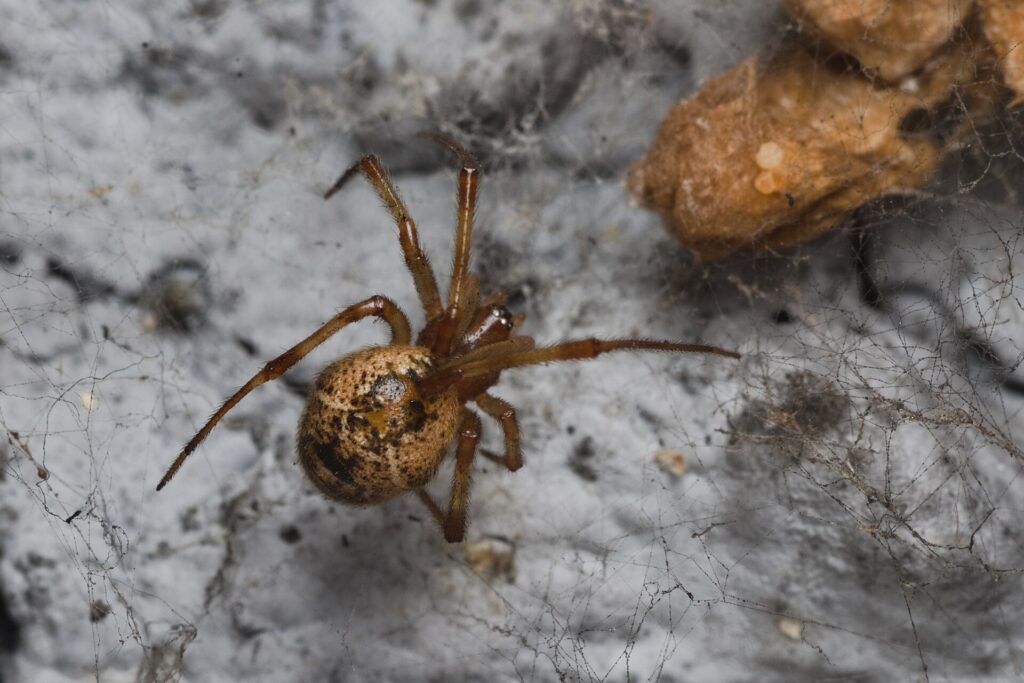
House spiders are common and generally harmless. (Image source: “Parasteatoda tepidariorum female Bytom” by Adrian Tync licensed under CC BY-SA 4.0, via Wikimedia Commons.)

The common house spider (Parasteatoda tepidariorum) is the one you have probably seen most often without knowing its name. It turns up across North Carolina in homes, garages, barns, and sheds, anywhere it can spin a tangled web and wait.
House spiders are not dangerous. Bites are rare and mild, and they eat flies and mosquitoes for you.
How to Identify House Spiders
House spiders are small, typically measuring between 3/16 and 5/16 of an inch in body length. Their coloring is usually a dirty yellowish-brown with darker brown streaks and a mottled pattern on the abdomen. The abdomen itself is rounded and tends to be larger in proportion to the rest of the body. Their legs have alternating light and dark rings.
2. Cellar Spider
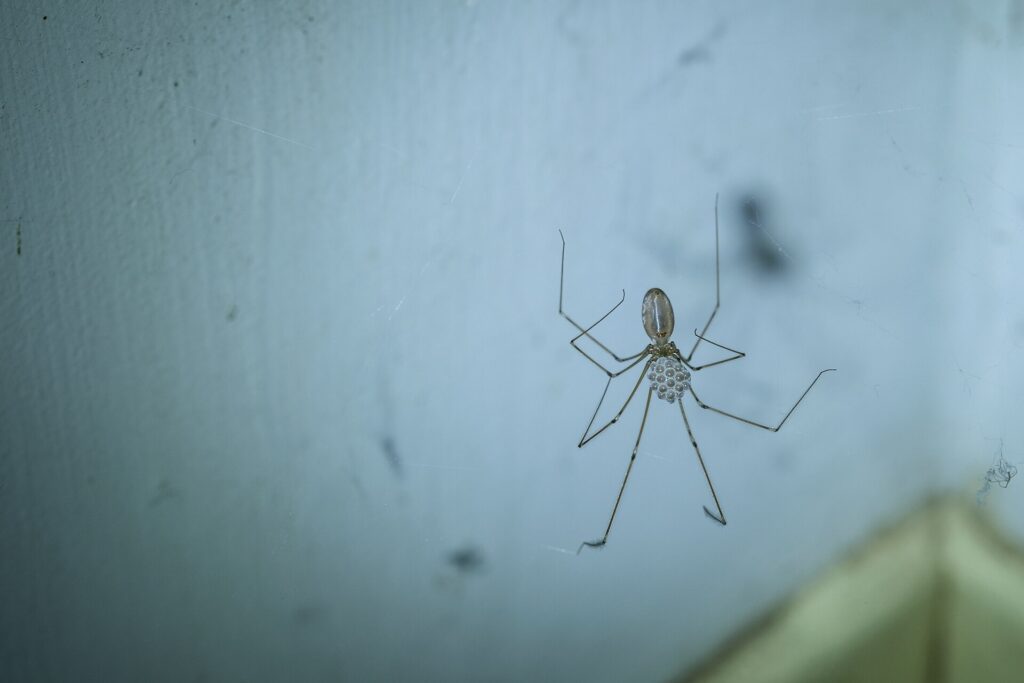
Cellar spiders have very long and thin legs. (Image source: “Cellar spider with eggs” by Priscilla Kang licensed under CC BY-SA 4.0, via Wikimedia Commons.)

Cellar spiders, often called daddy longlegs spiders, are easy to spot in North Carolina homes. Their legs are extremely long and thin compared to their tiny bodies.
Look for them hanging upside down in loose, messy webs in dark corners, basements, crawl spaces, closets, and under furniture. Disturb one, and it vibrates fast in its web, turning blurry and hard to grab.
How to Identify Cellar Spiders
The body of a cellar spider is tiny (usually between 1/4 and 3/8 of an inch), but the legs can extend up to 2 inches, making the entire spider appear much larger than it actually is. The body is pale yellow to light gray or brown, often nearly translucent. Unlike other spiders, cellar spiders have a distinctly elongated cylindrical abdomen rather than a rounded one.
3. Orb Weaver Spider
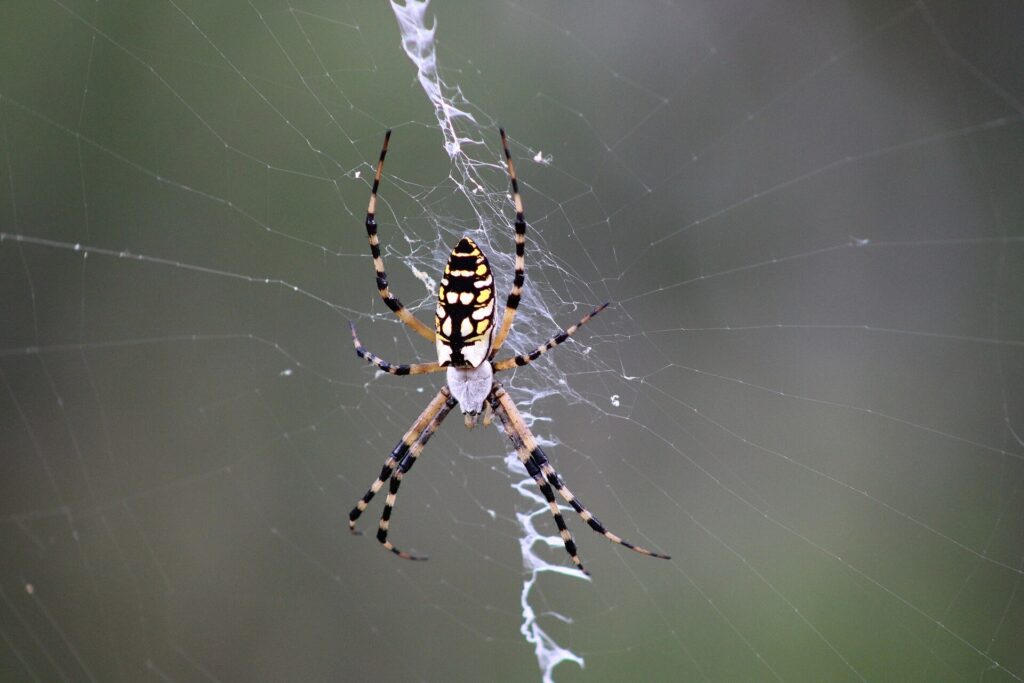
Yellow garden spiders are types of orb-weaver spiders. (Image source: “Yellow Garden Spider in a web” by Jolieokefenokee licensed under CC BY 4.0, via Wikimedia Commons.)

Orb weavers are the architects of the spider world. Walk face-first into a perfect wheel-shaped web in your garden at dusk, and you’ve met one. North Carolina has many species in the family Araneidae, and they are some of the most eye-catching spiders in the state.
They are harmless to humans. They peak in late summer and fall, when their webs can stretch up to two feet across. Gardeners benefit, since orb weavers eat huge numbers of flying insects.
How to Identify Orb Weaver Spiders
Orb weavers differ in size and color by species, but most have large, rounded abdomens patterned in yellow, orange, red, and black. The spiny orb weaver (Gasteracantha cancriformis), one of North Carolina’s most distinctive species, has a hard white abdomen with black spots and six red spines along the edges.
The web is the clearest clue: circles inside circles with spokes running to a central hub. Many orb weavers sit head down at that center, waiting for a trapped insect to shake the silk.
4. Yellow Sac Spider
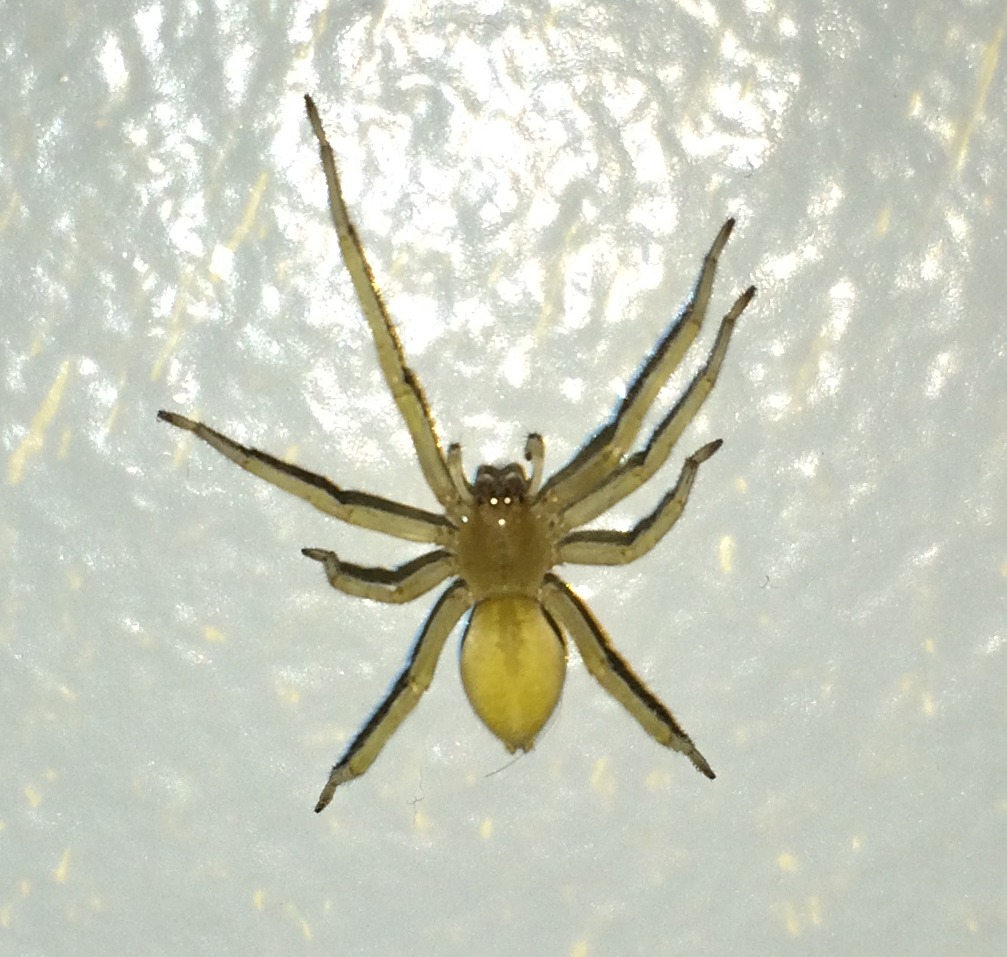
Yellow sac spiders may bite when they feel cornered. (Image source: “Yellow-sac-spider” by Austin Campbell licensed under CC BY-SA 4.0, via Wikimedia Commons.)

The yellow sac spider (Cheiracanthium inclusum) is mildly venomous and quick to bite when cornered, which is why it accounts for so many spider bites in North Carolina. They hunt at night instead of building webs, and that roaming brings them indoors. By day, they rest in a small silken sac tucked into a corner or under leaf litter.
How to Identify Yellow Sac Spiders
Yellow sac spiders are small, typically between 1/4 and 3/8 of an inch in body length. Their coloring is the most distinctive feature: a pale yellow to cream or light green tone that’s fairly uniform across the entire body. The legs are slightly darker at the tips, and the abdomen may show a faint darker stripe running down the center.
5. Jumping Spiders
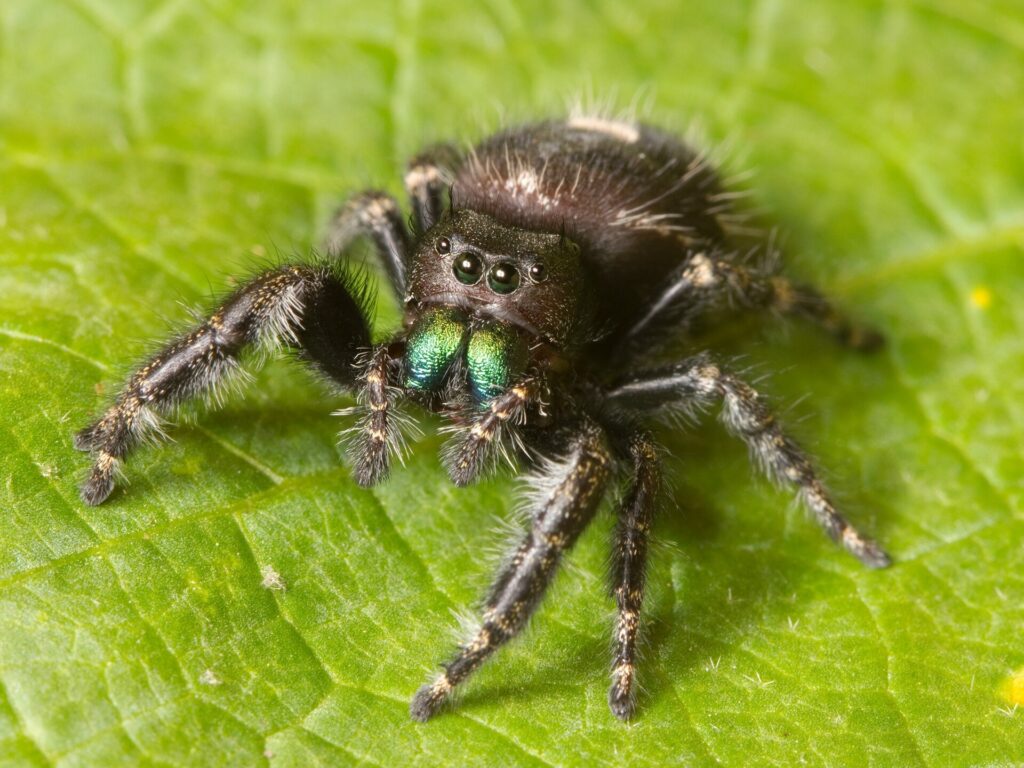
Jumping spiders have two very large eyes facing forward. (Image source: “Kaldari Phidippus audax 01” by Kaldari licensed under CC0 1.0, via Wikimedia Commons.)

Jumping spiders are the friendliest-looking spiders in North Carolina, and one will often turn and watch you instead of running. The family Salticidae includes many local species, most commonly the bold jumping spider (Phidippus audax).
They hunt by day, using big front eyes to judge distance before each leap, with a silk dragline trailing behind as a safety line. They are harmless, and you will see them on sunny walls and fences.
How to Identify Jumping Spiders
The bold jumping spider, the most recognizable species in NC, is compact and stocky (1/4 to 3/4 of an inch), with a black body marked by white spots or bands. Its fangs can flash an iridescent blue-green in direct light.
Jumping spiders have eight eyes, but four face forward in a row, and the middle two are strikingly large.
6. Black Widow Spider
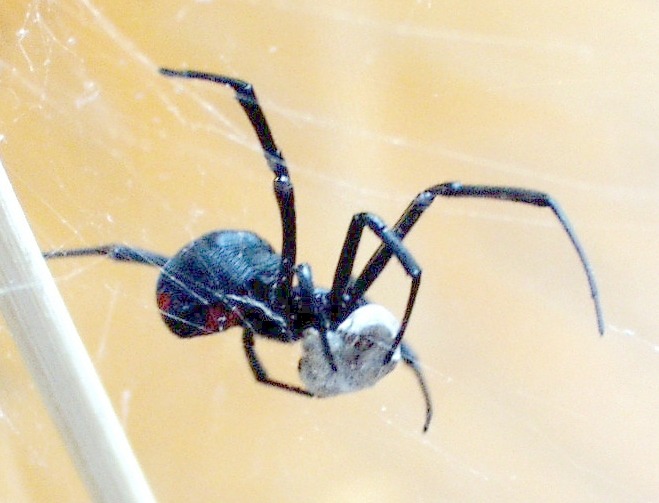
Black widow spiders have potent venom. (Image source: “Latrodectus mactans eating” by Kim licensed under CC BY 2.0, via Wikimedia Commons.)

The black widow (Latrodectus mactans) is the spider that commands the most respect in North Carolina. It carries one of the most potent venoms of any spider in North America, with a neurotoxin called alpha-latrotoxin that causes a condition known as latrodectism: severe muscle cramps, pain radiating through the abdomen and chest, sweating, and nausea. Healthy adults rarely die from black widow bites, but the experience is serious enough to require medical attention.
How to Identify Black Widow Spiders
The adult female is the easiest spider to identify in North Carolina. She is glossy jet black with a red hourglass on the underside of her rounded abdomen. Body length is about 1/2 inch, or up to 1-1/2 inches with the legs included.
Males are smaller and less dangerous. Look in dark, undisturbed spots: woodpiles, hollow logs, under outdoor furniture, meter boxes, and cluttered garages. Their webs are tangled, close to the ground, and unusually strong and sticky.
Common Spiders in North Carolina: Summary Table
| Spider | Size | Key Identifier | Venomous? | Typical Habitat |
| House Spider | 3/16 to 5/16 in. | Yellowish-brown, mottled pattern | No | Indoors, corners, garages |
| Cellar Spider | ¼ to 3/8 in. body; legs up to 2 in. | Extremely long thin legs, pale body | No | Basements, crawl spaces |
| Orb Weaver | Up to 1.1 in. | Circular web, bright patterned abdomen | No | Gardens, shrubs, tree lines |
| Yellow Sac Spider | 1/4 to 3/8 in. | Pale yellow/cream, silken sac retreat | Mildly | Walls, ceilings, leaf litter |
| Jumping Spider | 1/4 to 3/4 in. | Large front eyes, compact black body | No | Sunny walls, fences, gardens |
| Black Widow | 1/2 in. body; ~1.5 in. with legs. | Red hourglass on black abdomen | Yes, seek medical attention | Woodpiles, garages, meter boxes |
Keep Spiders Away from Your Home with Connor’s Pest Pros
Knowing which spider you are looking at changes what you do next. A cellar spider in the basement can stay. A black widow in the woodpile cannot. Once you see the same species week after week, the issue is no longer one spider but the conditions inviting them in.
We treat the cracks, corners, and clutter zones where spiders nest and hunt, using eco-friendly products safe around pets and kids. Our seasonal plans adjust as populations shift, and every visit is backed by our satisfaction guarantee. Request your free estimate today, and we will schedule your inspection same-day or next-day.
Frequently Asked Questions (FAQs)
What is the most dangerous spider in North Carolina?
The black widow spider (Latrodectus mactans) is widely considered the most dangerous spider in North Carolina. Its venom contains alpha-latrotoxin, a neurotoxin that triggers severe muscle pain, cramping, sweating, and nausea. While fatalities are rare in healthy adults, bites always warrant immediate medical attention.
What is the most common spider in NC?
The common house spider (Parasteatoda tepidariorum) is the spider most North Carolina residents encounter on a daily basis. It’s found in virtually every home across the state, quietly building messy cobwebs in corners, behind furniture, and in undisturbed areas like garages and basements.
What is the largest spider in NC?
The Carolina wolf spider (Hogna carolinensis) is the largest spider in North Carolina. Bodies reach about 1.4 inches, and the wide leg span makes them look bigger still. They are not dangerous to people. Wolf spiders hunt on the ground using speed and sharp eyesight instead of webs, and they keep local insect numbers down.
What is the most poisonous spider in NC?
Spiders are venomous, not poisonous. Venom gets injected; poison gets swallowed or touched. The black widow has strong venom that is widely described as more potent drop-for-drop than rattlesnake venom, though a bite delivers far less of it.
What services does Connor’s Pest Pros offer?
Connor’s Pest Pros covers residential and commercial pest control, termite and bed bug treatment, mosquito and rodent control, plus pest repairs. Same-day or next-day service is available, backed by a 100% satisfaction guarantee with free re-treatments if pests return.
*Price estimates reflect current market costs and may vary based on your specific situation. For a personalized quote tailored to your needs, contact us directly or request your FREE estimate today!