
Key Takeaways
- Snake scat can carry Salmonella, and dried bird droppings release fungal spores when disturbed, so leaving either to build up in an attic or crawl space turns an ID question into a real health risk.
- Snake scat is soft and smeared, holds bones, fur, or scales from whole prey, and scales up with the size of the snake that left it.
- Bird droppings are two-toned with white uric acid around a darker center, and they harden into a chalky crust as they age.
- Shape and contents settle it fastest: elongated with prey remains means snake; splattered with no bone fragments means bird.
- Connor’s Pest Pros handles snakes, rodents, and other household pests across Metro DC and NOVA, so you can stop guessing and treat the source.
Identifying the Pest by Its Poop
Snake droppings and bird droppings both contain white uric acid, so a quick glance can be misleading. The difference is in the shape and what’s inside. Snake scat is tube-shaped and often holds bones, fur, or scales from swallowed prey, while bird poop is splattered or circular and never contains prey remains.
The other clue is where the droppings turn up. Snakes leave scat in tucked-away spots like attics, crawl spaces, and woodpiles, while bird droppings land on ledges, rooftops, and rafters where they roost. So the location can point you toward the animal before you look at a single dropping up close.
Getting it right matters. Both types carry bacteria you do not want spreading in an attic or crawl space. Droppings that keep piling up in the same spot also signal something living inside rather than an animal that wandered through once.
If the signs point to a snake, or to the rodents that attract them, we can help. Connor’s Pest Pros handles snakes, rodents, and other household pests across Metro DC and NOVA, so you can stop guessing and get the problem sorted properly.
Connor’s Pest Pros: Trusted, Family-Owned Pest Control
4.9★ Google Rating | 100% Satisfaction Guarantee

Protect Your Home, Pest-Free:
Get customized, ongoing pest control that adjusts with the seasons, covering everything from ants and spiders to termites, rodents, and bed bugs. Same-day or next-day visits mean fast relief.
What Sets Us Apart:
✓ 950+ 5-star reviews on Google
✓ Family-owned, D.C. metro area
✓ Member of the NPMA
✓ Angi Super Service Award Winner (2024)
✓ 100% Satisfaction Guarantee
Don’t let pests take over your home. Act now.
Request Your Free Estimate →How To Identify Snake Poop: Physical Characteristics to Know
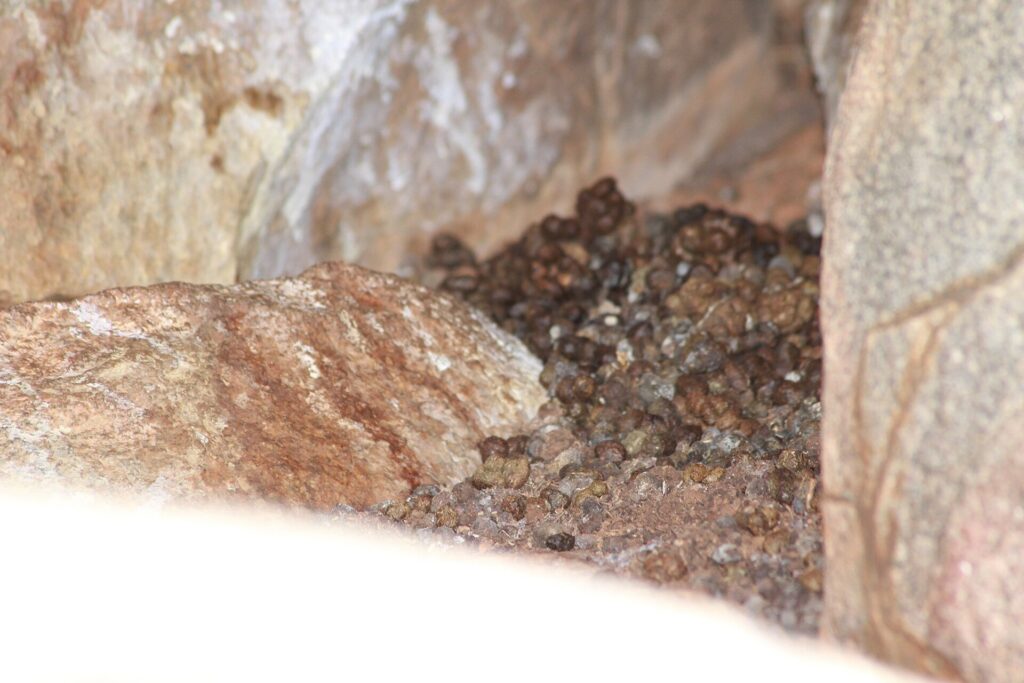
Snake poop’s brown color makes it hard to distinguish from feces of other carnivorous animals. (Image source: “Faeces and droppings of Snakes 2” by Mompati Dikunwane licensed under CC BY-SA 4.0, via Wikimedia Commons.)

Snake poop doesn’t look dramatic, but each characteristic tells a clear story about the animal that left it.
Color & Texture of Snake Feces
Snake feces are usually dark brown, which makes them easy to confuse with the droppings of other carnivores. The texture is more liquid than solid, largely because snakes consume no plant fiber whatsoever.
White Urate Cap
Snakes excrete both fecal matter and urine simultaneously through their cloaca. The result is a brown deposit with a distinctive white urate cap, sometimes appearing as white streaks running along the length of the dropping. This urate cap is one of the most consistent visual identifiers of snake waste. Keep in mind that birds and lizards also produce white uric acid, which is exactly why context and shape matter so much.
Bones, Hair, & Scales Inside Snake Poop
Because snakes swallow prey whole, their digestive systems can’t fully break down everything. Bones, hair, fur, feathers, and scales often pass through intact and end up visible in the droppings. In larger snake species like rat snakes or pythons, the bones can be quite obvious. This is arguably the most definitive identifier: if you see prey remnants in the dropping, you’re looking at snake scat, not bird droppings.
Size
Snake droppings generally scale with the size of the snake that produced them. A small garter snake leaves thin, small deposits, while a large rat snake produces noticeably larger, thicker droppings. This is practically useful information: if the scat you’re looking at is large, you’re not dealing with a small garden snake.
Pay attention to where you find the droppings, too. Scat found in an attic or crawl space in concentrated areas often signals a snake that has taken up residence.
How To Identify Bird Poop: Physical Characteristics to Know
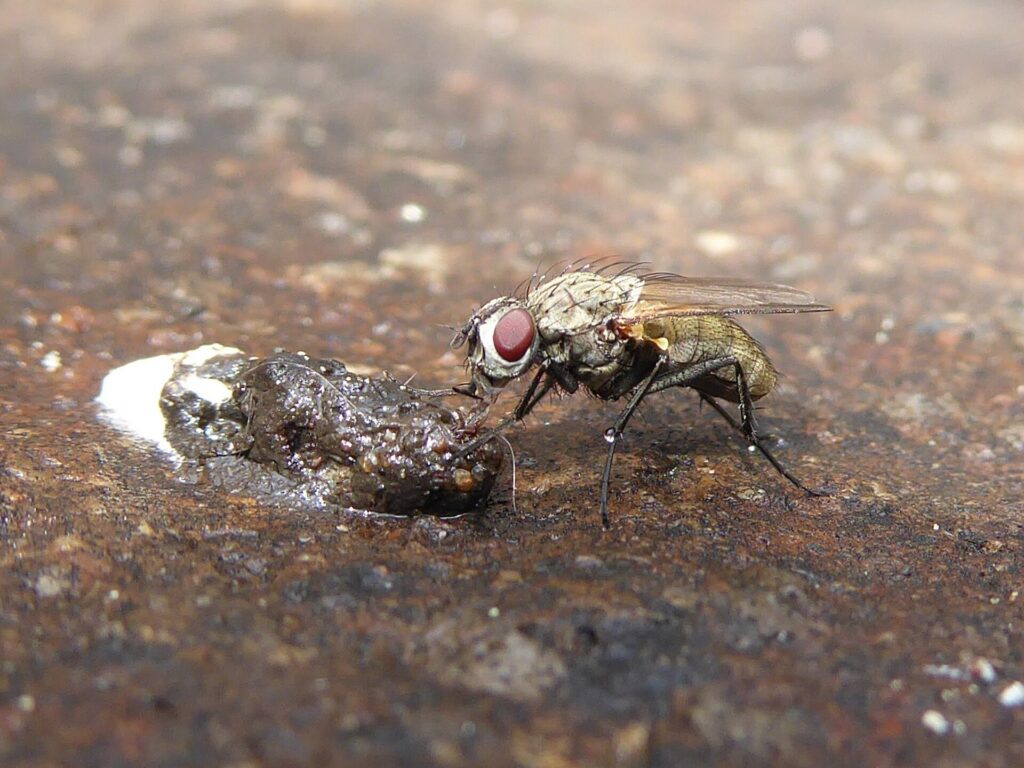
Bird poop usually has a dark and relatively solid substance at the center and white, pasty liquid at the side. (Image source: “Unidentified fly feeding” by Syrio licensed under CC BY-SA 4.0, via Wikimedia Commons.)

Bird droppings are everywhere, but most people have never actually studied what they look like up close. Understanding the anatomy of bird poop makes it much easier to distinguish from snake scat when you find it somewhere unexpected, like your attic or garden shed.
Dark & Solid Center
Fresh bird droppings have a distinctly two-toned appearance. The center is dark (typically brown, green, or black depending on the bird’s diet) and relatively solid compared to the surrounding material. This dark center is the actual fecal matter, the digested food waste moving through the bird’s intestines.
However, the fecal center doesn’t always look the same, as birds may vary in diet. The white uric acid surrounding it, however, stays consistent regardless of species.
White Pasty Liquid Substance at the Side
That white, paste-like material surrounding the dark center is uric acid, the way birds excrete nitrogenous waste. Birds also filter waste through their kidneys, but unlike mammals (which expel it as liquid urine), birds convert nitrogen into uric acid, a semi-solid compound that requires very little water to excrete.
The uric acid portion is what most people notice first because it’s bright white and spreads outward from the center. In fresh droppings, it’s soft and paste-like. As it dries, it becomes thicker and harder, eventually forming the chalky white crust that’s so familiar on car windshields and park statues. The amount of white relative to the dark center varies by bird species and hydration level, but it is always present in bird droppings.
Old Bird Droppings: Hardened, Dry, White, Chalky
Aged bird droppings look nothing like fresh ones, which is why they’re often misidentified entirely. Over time, the moisture evaporates and what remains is a hardened, crusty, chalky white or gray deposit. The dark fecal center may still be faintly visible underneath, or it may have degraded entirely. Build-ups like these are the ones worth treating carefully, since disturbing dried droppings can release fungal spores into the air.
In outdoor settings, old bird droppings are almost always white and chalky: flat, layered deposits that have built up over time. Indoors, you may find them in corners, along rafters, or beneath entry points where birds have been roosting consistently.
Snake Poop vs Bird Poop: Comparison Table
| Feature | Snake Poop | Bird Poop |
| Color | Brown with white urate cap or streaks | Dark center with white uric acid around it |
| Texture | Soft and moist, often smeared at the edges | Pasty when fresh, chalky when dry |
| Shape | Elongated, tube-like | Splattered or circular |
| Contents | Bones, fur, feathers, or scales | No prey remnants |
| Size | Matches the snake’s size | Small and fairly uniform |
| Where you find it | Attics, crawl spaces, basements, woodpiles | Ledges, rooftops, car hoods, rafters |
Identify the Poop Then Address the Real Concern with Connor’s Pest Pros

If you’re dealing with a pest infestation, Connor’s Pest Pros can help.
Knowing what left the droppings tells you what you are actually dealing with. Prey bones and white-capped streaks point to a snake living somewhere in your home, and that usually means rodents drew it in. Once you can name the source, you can act before the problem settles in for good.
If snakes or the rodents feeding them have found a way inside, we can handle both. Our team serves Metro DC and the wider NOVA area with same-day treatments that are safe around pets and kids. Request your free estimate today, and we will take it from there.
Frequently Asked Questions (FAQs)
What color is snake poop typically?
Snake poop is usually brown, which makes it hard to distinguish it from the droppings of other animals. It almost always has white urate streaks or a white cap alongside the brown deposit, since snakes expel both fecal matter and urine simultaneously through their cloaca. The brown portion can range from dark to medium brown depending on the snake’s recent diet and digestion cycle.
Does snake poop stink in the house?
Yes, snake poop smells, and when it builds up in an enclosed space like an attic or crawl space, the odor becomes significant. Snake feces may carry Salmonella bacteria, so accumulated droppings are a real health concern on top of the smell. Accumulation of droppings in a confined area is one of the clearest signs that a snake has established a long-term presence rather than just passing through.
How can I identify bird poop?
Bird poop has a dark center (brown, black, or green) surrounded by white uric acid. It looks splattered or circular rather than elongated, and it never contains bones, fur, or scales. Older droppings dry into a hard, chalky white or gray crust, often found on ledges, rooftops, car hoods, or along indoor rafters.
Is it safe to clean bird poop?
Fresh bird droppings on an outdoor surface are generally low risk if you avoid direct skin contact and wash your hands afterward. For small, fresh deposits on outdoor surfaces, a paper towel, mild disinfectant, and gloves are sufficient.
Dried indoor accumulations are a different matter: do not sweep or vacuum them dry, since that puts fungal spores into the air. Mist the area with water first, wear gloves and an N-95 respirator, and call a professional for anything larger than a small patch.
What services does Connor’s Pest Pros offer?
Connor’s Pest Pros handles residential and commercial pest control, termite treatment, bed bug treatment, mosquito control, rodent control, wildlife control, and pest repair services. Our exterminators serve Metro DC and the wider NOVA area, including Virginia and Maryland, with same-day services. Every service is backed by a 100% satisfaction guarantee, so if pests come back, we return for a free re-treatment.
*Price estimates reflect current market costs and may vary based on your specific situation. For a personalized quote tailored to your needs, contact us directly or request your FREE estimate today!