
Key Takeaways
- Coyote scat is rope-like, twisted, and tapered with visible fur or bones; raccoon scat is dark, blunt-ended, and repeatedly deposited in a communal latrine site.
- Raccoon droppings are commonly 2–3 inches long and about 1/2 inch wide; coyote scat is generally 3–5 inches long and 0.75-1.5 inches in diameter, often containing animal hair and bone fragments.
- Location is one of the strongest identification clues: coyote scat appears along travel routes and territory markers, while raccoon scat repeatedly accumulates in the same spot.
- Both coyote and raccoon droppings carry serious health risks, including parasites and pathogens, and should never be handled without proper protection.
- Connor’s Pest Pros offers humane wildlife and pest removal services with same-day and next-day availability and a 100% satisfaction guarantee.
What’s the Difference Between Coyote Poop & Raccoon Poop?
Coyote scat is generally longer and thicker than raccoon droppings, comparable to a medium-sized dog’s droppings. Raccoon droppings are more consistent in size, typically 2–3 inches long with a width close to 1/2 inch.
Shape is another key difference. Coyote scat is rope-like, twisted, and braided, with tapered ends. Raccoon scat is more uniform and log-like, blunt-ended, and often broken into shorter cylindrical pieces without significant twisting.
If you find repeated deposits in one area of your yard, it indicates wildlife is encroaching on your space. Connor’s Pest Pros addresses wildlife activity at the source, providing tailored plans for each property and follow-up visits to ensure the problem is fully resolved.
Connor’s Pest Pros: Trusted, Family-Owned Pest Control
4.9★ Google Rating | 100% Satisfaction Guarantee

Protect Your Home, Pest-Free:
Get customized, ongoing pest control that adjusts with the seasons, covering everything from ants and spiders to termites, rodents, and bed bugs. Same-day or next-day visits mean fast relief.
What Sets Us Apart:
✓ 950+ 5-star reviews on Google
✓ Family-owned, D.C. metro area
✓ Member of the NPMA
✓ Angi Super Service Award Winner (2024)
✓ 100% Satisfaction Guarantee
Don’t let pests take over your home. Act now.
Request Your Free Estimate →What Does Coyote Poop Look Like?
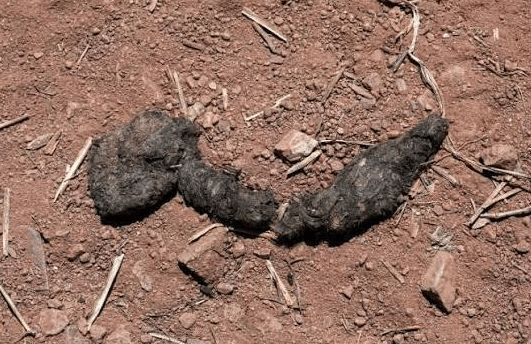
Coyote scat has a distinctive rope-like appearance that sets it apart from most other wildlife droppings you’ll encounter in North America (image source: Colorado Arts & Science Magazine).
Coyote scat is usually tubular, segmented, and twisted, often tapering to a point on one or both ends. That tapered tip is one of the most reliable visual markers you can spot from a distance.
The contents of coyote scat shift with the seasons and available food sources. In colder months when small mammals are the primary prey, you’ll frequently see compact animal fur woven through the scat, along with tiny bone fragments and occasionally feathers.
In warmer months when berries and fruit become part of the diet, scat can look lighter, sometimes reddish-brown, softer, and less obviously predatory, which is one reason identification based on appearance alone can mislead you.
What Does Raccoon Poop Look Like?
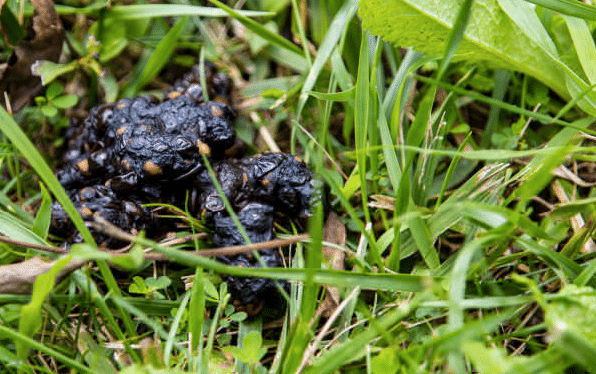
Raccoon scat is dark, tubular, and blunt-ended, and it tends to break into shorter segments (image source: Reddit).
Unlike the twisted-rope look of coyote scat, raccoon droppings are more log-like and uniform. The odor is noticeably strong, often described as musky and unpleasant even from a short distance.
The contents of raccoon scat reflect the animal’s famously opportunistic diet. You’ll frequently find undigested seeds, berry skins, corn kernels, insect parts, and other plant material mixed into the droppings. This contrasts with coyote scat, which more often contains prey remnants like fur and bone. When you see a scat full of seeds and plant matter, raccoon should move to the top of your list.
How to Tell Coyote Poop Apart From Raccoon Poop
- Check the Shape & Size From a Distance: Coyote scat is roughly 3–5 inches long and 0.75 to 1.5 inches in diameter; it typically looks rope-like, twisted, and tapered, sometimes resembling a braided cord with pointed ends. Raccoon scat typically measures about 2–3 inches long and roughly 1/2 inch wide and looks more like a segmented log: blunt, uniform, and broken into shorter cylindrical pieces without significant twisting.
- Look at the Contents Without Touching: Crouch down and look closely without disturbing the scat. Dense animal fur matted through the deposit is one of the strongest coyote indicators you can find in the field. Tiny bone fragments, feathers, or insect chitin point the same direction. If instead you see berry seeds, corn kernels, plant material, or insect parts that look more like a garden than a predator’s meal, raccoon is the more likely candidate.
- Note the Location: A single dropping on an elevated rock, trail junction, fence post, or other exposed landmark fits coyote scent-marking behavior. Coyotes use these spots to communicate territorial information to other coyotes passing through. If you see a substantial accumulation of droppings in varying stages of decomposition on a flat surface like a deck, roof, or large stump, that pattern is far more consistent with a raccoon latrine.
- Look for Nearby Tracks: Search the surrounding soil, mud, or sand without walking directly over the scat area, which can disturb evidence and increase your exposure risk. Coyote tracks are canine in structure: four toes arranged in an oval pattern, with claw marks that typically register in soft ground. Raccoon tracks resemble a small human hand, with five long, separated toes that spread outward from a broad palm pad.
- Watch for Repeat Deposits: If you are uncertain, come back to the same location after a few days. A raccoon latrine will show new material added to an existing pile, often with droppings in different stages of decomposition layered on top of each other. This compounding pattern is one of the clearest behavioral distinctions between the two species. Coyotes do revisit scent-marking sites, but they rarely produce the dense accumulation of a raccoon latrine.
What to Do After You Identify the Scat
Identification is only the first step. Both raccoon and coyote droppings carry real health risks. If you find an established raccoon latrine on your property, standard cleaning is not enough on its own. The area needs proper disinfection, and you must identify and remove the attractants drawing the animals back.
Coyote activity near a residence, especially repeated scent marking, can also signal a habituation problem that tends to escalate over time without intervention. Document what you find, including photographs with a size reference, then contact wildlife removal experts to identify the animal and outline the next steps. The photos you provide give any wildlife professional a useful starting point for assessing the situation.
Coyote Poop vs Raccoon Poop: Comparison Table
| Feature | Coyote Scat | Raccoon Scat |
| Length | Often roughly 3–5 inches long | Typically 2–3 inches |
| Width | 0.75 to 1.5 inches in diameter | Approximately 1/2 inch |
| Shape | Rope-like, twisted, tapered ends | Log-like, blunt-ended, segmented |
| Color | Dark brown to black when fresh; fades to gray or chalky white with age | Dark brown to black, glossy when fresh |
| Contents | Animal fur, bone fragments, feathers | Seeds, berry skins, corn, insect parts |
| Placement | Trail edges, fence lines, territory markers | Fixed latrine sites, decks, rooftops, stumps |
| Deposit Pattern | Single or sparse deposits along travel routes | Repeated accumulation in the same location |
| Odor | Strong, musky | Very strong, noticeably unpleasant |
Keep Your Property Safe From Wildlife With Connor’s Pest Pros

Connor’s Pest Pros is a family-owned and operated pest control company, a family business dating back to 1944 with over 80 years of experience in pest control.
Finding raccoon or coyote droppings on your property signals that wildlife has made your space a regular stop. A single deposit is one thing; a latrine site or repeated scent marking is a pattern that tends to escalate. The longer these animals use your yard, deck, or attic as a regular stop, the harder the habit becomes to break without professional intervention.
At Connor’s Pest Pros, we identify the animal disturbing your yard, what draws it back, and how to address the issue at the source. Our team provides humane treatment and removal plans customized to each unique wildlife problem, backed by a 100% satisfaction guarantee and same-day or next-day availability. Request a free quote from Connor’s Pest Pros to begin.
Frequently Asked Questions (FAQs)
How can I tell the difference between raccoon and coyote poop?
The most reliable way is to assess shape, contents, and location together. Coyote scat is rope-like, twisted, and tapered with visible fur or bones inside. Raccoon scat is blunt, log-like, and dark, typically found in a repeated pile at a fixed latrine site. A single deposit along a trail or fence line favors coyote; an accumulating pile on a deck or rooftop strongly favors raccoon.
How big is raccoon poop?
Raccoon droppings are typically 2–3 inches long and approximately 1/2 inch wide. They are broken into shorter blunt segments and tend to accumulate in piles at established latrine sites rather than appearing as single isolated deposits.
What color is raccoon feces?
Raccoon feces is usually dark brown to black and often appears glossy when fresh because of its moisture content. Color shifts depending on diet; a raccoon feeding heavily on berries may produce darker, almost purplish droppings, while one eating corn will leave lighter-toned scat with visible kernels.
What does coyote stool look like?
Coyote stool is rope-like, twisted, and typically tapered to a point at one or both ends. It often contains visible animal fur, small bone fragments, feathers, or insect parts. It is generally deposited as a single specimen along a trail, fence line, rock, or other exposed territorial marker rather than accumulated in a pile.
Does Connor’s Pest Pros offer same-day service for wildlife removal?
Yes, Connor’s Pest Pros offers same-day and next-day appointments across the DC metro area, so you will not be left waiting days while an animal settles in. Every wildlife job starts with a free inspection to locate entry points and confirm what is living on the property, and the company’s technicians follow that with humane removal and exclusion work to seal the gaps behind it.
*Price estimates reflect current market costs and may vary based on your specific situation. For a personalized quote tailored to your needs, contact us directly or request your FREE estimate today!