
Key Takeaways
- Chigger bites form in lines along tight clothing seams, while ant bites appear as isolated red bumps, with fire ant stings developing into pimple-like pustules.
- Chigger bite symptoms peak in the first 24–48 hours and can last up to two weeks, whereas ant bites typically resolve within a week.
- Chigger bites are treated with hydrocortisone cream, aloe vera gel, and diluted tea tree oil to reduce inflammation and stop the itch response.
- Ant bites respond well to hydrocortisone cream, apple cider vinegar, and raw honey, with fire ant bites often benefiting from an oral antihistamine.
- If chiggers or ants keep showing up around your home, Connor’s Pest Pros offers targeted ant treatments and outdoor pest control across the Metro DC and NOVA area, all backed by a 100% satisfaction guarantee.
How to Tell Chigger & Ant Bites Apart
The biggest visual difference between chigger and ant bites is pattern. Chiggers leave a signature trail of tiny welts along clothing lines, while ants leave scattered marks wherever exposed skin made contact. What both have in common is that they itch, sometimes intensely, and both point to specific outdoor environments where you are most likely to encounter them.
Chiggers live in grassy fields, wooded areas, and heavily vegetated pockets around the yard, usually in warmer and more humid months. Ants are far more widespread, showing up along garden paths, near food sources, and inside kitchens and bathrooms when a colony finds its way indoors.
For homeowners dealing with pest pressure indoors and out, Connor’s Pest Pros provides expert guidance on identifying and eliminating the source of bites at the property level.
Connor’s Pest Pros: Trusted, Family-Owned Pest Control
4.9★ Google Rating | 100% Satisfaction Guarantee

Protect Your Home, Pest-Free:
Get customized, ongoing pest control that adjusts with the seasons, covering everything from ants and spiders to termites, rodents, and bed bugs. Same-day or next-day visits mean fast relief.
What Sets Us Apart:
✓ 950+ 5-star reviews on Google
✓ Family-owned, D.C. metro area
✓ Member of the NPMA
✓ Angi Super Service Award Winner (2024)
✓ 100% Satisfaction Guarantee
Don’t let pests take over your home. Act now.
Request Your Free Estimate →What Do Chigger Bites Look Like: Identification Tips
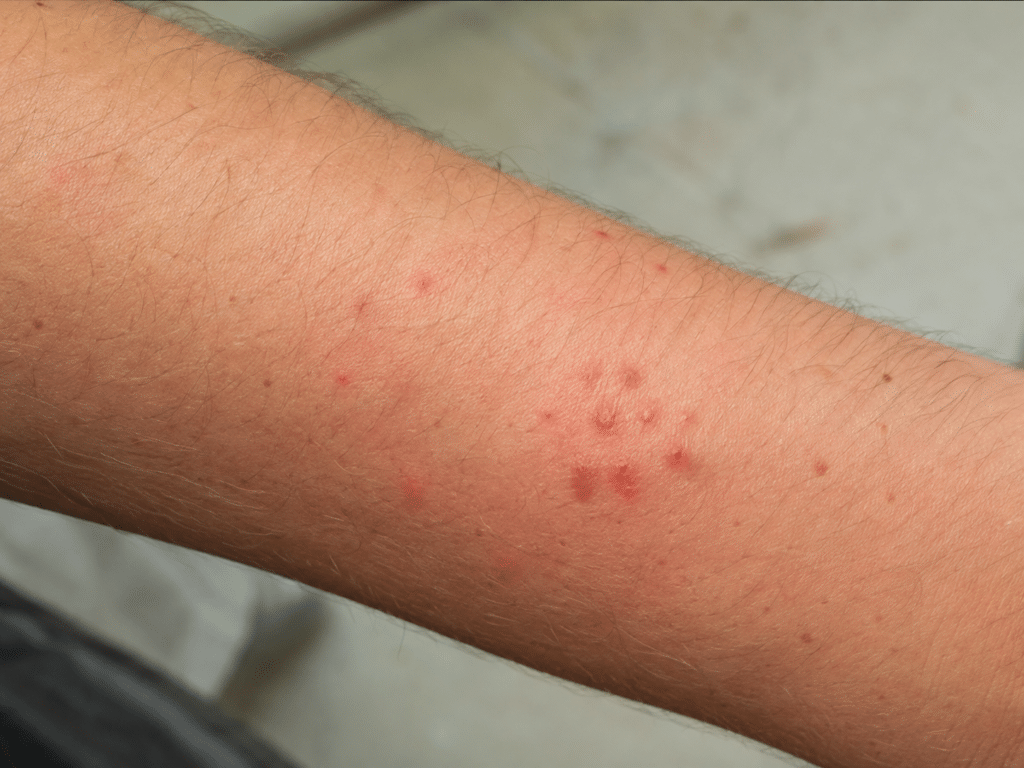
Chigger bites tend to remain small and clustered together, giving the affected area a speckled, dotted appearance rather than one large raised welt.
Color
Chigger bites appear as bright red spots on the skin, often surrounded by a slightly inflamed, pinkish halo. In some cases, the center of the bite may look like a small pimple or raised papule with a darker red center where the feeding occurred.
Size
Each chigger bite is small, typically ranging from 1 to 2 millimeters in diameter when it first appears. Over the next 24 to 48 hours, the surrounding skin can become more inflamed, and the welt may grow slightly larger because of the body’s immune response to the injected enzymes.
Location on Body
The most common locations for chigger bites are areas where clothing presses against the skin, such as around the waistline, ankles, behind the knees, in the groin area, and around the armpits. If you notice a line of red bites along your sock line or waistband after spending time in tall grass or wooded areas, chiggers might be the cause.
What Do Ant Bites Look Like: Identification Tips
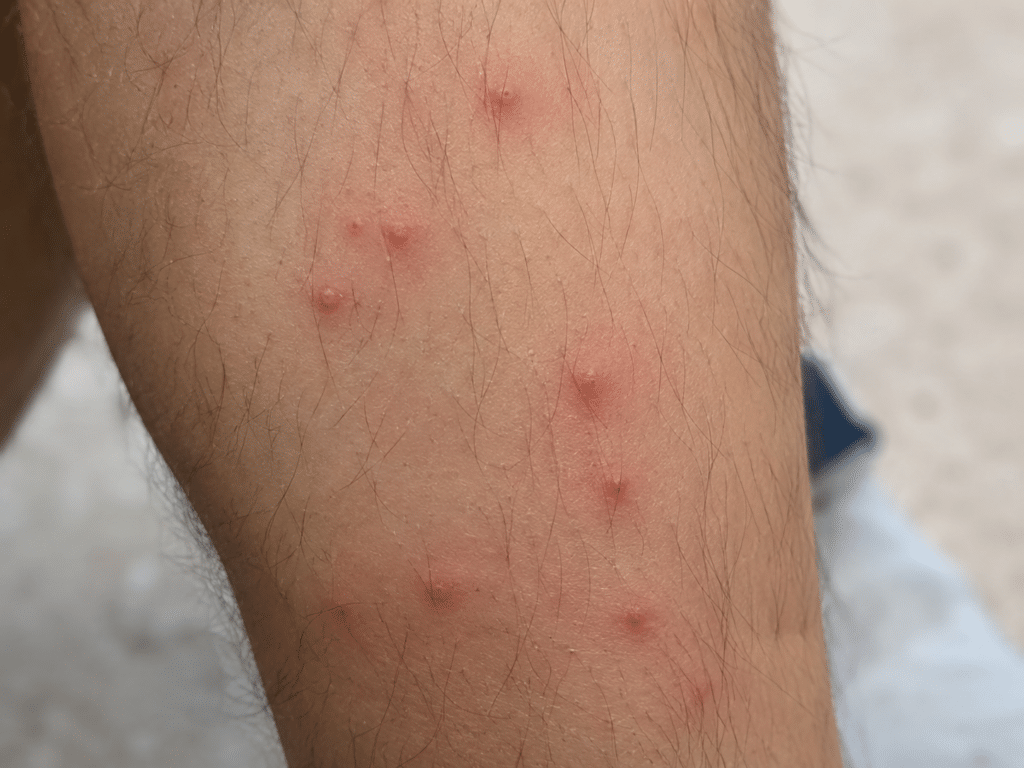
Common ant bites appear as simple red bumps, while fire ant bites often develop into pustules.
Color
Common ant bites from species like carpenter ants or black ants tend to stay as a simple red raised bump without progressing to a pustule.
However, fire ant bites evolve quickly and distinctly. Within a few hours of being stung, a fluid-filled blister forms, and by about 24 hours it develops into a swollen, pus-filled pustule with a white or yellowish center surrounded by red, irritated skin.
Size
Ant bites are generally small, comparable in initial size to a chigger bite. Fire ant pustules stay small but become raised and fluid-filled over the first 24 hours, with a red halo around each one. Popping these blisters is strongly discouraged, as it increases the risk of secondary infection.
Location on Body
Unlike chigger bites that cluster near clothing seams, ant bites appear wherever exposed skin made contact with the ant. Feet, ankles, and lower legs are most commonly affected because most ant encounters happen at ground level.
Treatment Options for Chigger Bites
1. Over-The-Counter Hydrocortisone Lotion
Over-the-counter hydrocortisone cream is one of the most effective and accessible treatments for chigger bites. It’s a mild topical steroid that reduces inflammation and the immune response triggered by chigger larvae saliva, which causes intense itching and redness.
Most drugstores carry 1% hydrocortisone cream without a prescription, and you can apply it several times a day to affected areas until symptoms subside.
2. Tea Tree Oil
Tea tree oil is a well-known antimicrobial and anti-inflammatory agent. When applied to chigger bites, it helps calm the skin’s inflammatory response and reduces the urge to scratch, which is critical, since scratching can break the skin and introduce bacteria.
Always dilute tea tree oil before applying it to skin. Mix 2 to 3 drops of tea tree oil with a carrier oil like coconut oil or jojoba oil before dabbing it onto the bite with a cotton ball.
3. Aloe Vera Gel
Pure aloe vera gel straight from the plant is one of the most versatile natural remedies for irritated skin. Its cooling effect provides immediate itch relief, while its active compounds work to reduce redness and support skin barrier repair.
Apply a thin layer of fresh aloe vera gel directly to each bite two to three times daily for best results.
Treatment Options for Ant Bites
1. Over-The-Counter Hydrocortisone Lotion
Over-the-counter hydrocortisone cream works well for ant bites because it calms the localized allergic reaction that causes the itching, redness, and swelling around each bite. It’s especially useful in the first 24 to 48 hours, when inflammation tends to peak.
A 1% strength is widely available at most drugstores and is safe for adults and children over age 2 when used as directed.
2. Apple Cider Vinegar
Apple cider vinegar is one of the most commonly recommended home remedies for ant bites. Its mild acidity and cooling effect may help soothe irritation, though clinical evidence for vinegar on insect stings is limited.
Soak a cotton ball in raw, unfiltered apple cider vinegar and hold it against the bite for 3 to 5 minutes. For multiple bites covering a larger area, dilute apple cider vinegar with equal parts water and apply using a clean cloth.
3. Raw Honey
Raw honey produces small amounts of hydrogen peroxide, which gives it mild antibacterial properties that may help keep a scratched bite clean. Apply a thin layer directly to the bite, cover loosely with a bandage if needed, and leave it on for 20 minutes before rinsing.
What to Do If You’ve Brought Chiggers Indoors
- Vacuum thoroughly: Cover all carpets, upholstered furniture, and baseboards. Empty the vacuum canister into a sealed bag outdoors immediately after.
- Wash exposed fabrics in hot water: Wash bedding, clothing, and towels in hot water (at least 120°F) and dry them on the highest safe setting, which extension services recommend for killing mites left on fabric.
- Treat the yard perimeter: Apply a targeted acaricide, focusing on shaded, moist areas with dense vegetation where chigger populations tend to thrive.
- Call a professional if the problem persists: A pest control specialist can identify hidden entry points, treat the property more thoroughly, and prevent the issue from repeating.
What to Do If You Find Ants in Your Home
- Remove food and moisture attractants. Store food in sealed containers, wipe down surfaces, and fix any leaking taps or damp spots.
- Seal entry points. Use caulk or weatherstripping to close cracks and gaps around windows, doors, and utility lines.
- Use commercial bait or diatomaceous earth on individual mounds: Commercial ant baits are carried back to the nest and can reduce colony populations over time; diatomaceous earth may kill foraging ants on contact but does not reach the colony.
- Bring in a professional for full elimination: A specialist can identify the specific ant species, locate hidden nests, and apply targeted treatments that stop the infestation at the source.
Chigger Bites vs Ant Bites: Comparison Table
| Characteristic | Chigger Bites | Ant Bites |
| Appearance | Red spots/pimples in a speckled line | Single red pimple-like mark or pus-filled white blister on red base |
| Bite Pattern | Clusters along clothing seams | Isolated bites, or multiple clustered bites in one area (fire ants). |
| Itch Level | Severe, peaks at 24–48 hours | Mild to severe burning and itching |
| When to See a Doctor | If fever, rash, or dark scabs appear | If infection signs develop |
Keep Chiggers & Ants Out of Your Home With Connor’s Pest Pros

Connor’s Pest Pros provides both commercial and residential pest control services, with same-day and next-day treatment.
Telling chiggers and ants apart matters, but treating the bites is only part of the picture. If either pest keeps returning, the real fix is at the source: yards, entry points, and colonies that need targeted, structured treatment rather than a spray-and-hope approach.
For homeowners in the Metro DC and NOVA area, Connor’s Pest Pros helps you take back your outdoor space. We offer targeted ant treatments for indoor and outdoor infestations, plus recurring seasonal service that keeps your yard and perimeter under control as pest activity shifts through the year. Every visit is backed by our 100% satisfaction guarantee, with free re-treatments if pests return before your next scheduled service. Request your free estimate today.
Frequently Asked Questions (FAQs)
What is the fastest way to get rid of chigger bites?
The fastest way to get rid of chigger bites is to shower immediately after outdoor exposure to remove any remaining larvae, then apply a cold compress to the affected area to reduce inflammation quickly. Follow up with an over-the-counter hydrocortisone cream or calamine lotion to suppress the itch response. Natural options like pure aloe vera gel and diluted tea tree oil can also improve comfort and speed recovery.
What is the best ointment to use on ant bites?
For common ant bites, over-the-counter hydrocortisone cream can reduce redness and itch. For fire ant bites specifically, a combination approach works best. Use hydrocortisone to address the inflammation, and add an oral antihistamine like diphenhydramine (Benadryl) if the itching is severe or spreading beyond the immediate bite site.
What gets mistaken for chigger bites?
Several common skin conditions and insect bites are frequently mistaken for chigger bites, including flea bites, bed bug bites, mosquito bites, and contact dermatitis from plants like poison ivy. The key difference is that flea bites often have a tiny puncture point visible at the center, while chigger bites often show a bright red dot at the center of a raised papule and cluster along clothing lines rather than on exposed ankles.
How do I identify chiggers?
Chiggers are the larval stage of Trombiculidae mites and are nearly impossible to see with the naked eye. You’re more likely to identify a chigger problem by recognizing the bite pattern than by spotting the mites themselves. The most reliable way to identify chiggers without laboratory confirmation is the signature speckled line of red bites along tight clothing after outdoor exposure in grassy or wooded areas.
Can Connor’s Pest Pros help with my ant problem?
Yes, at Connor’s Pest Pros, we handle both fire ant infestations and common household ant problems with targeted treatment strategies designed to eliminate the colony. Our team identifies the ant species, locates hidden nests, and applies targeted, pet- and child-safe treatments that stop the problem at the source.
*Price estimates reflect current market costs and may vary based on your specific situation. For a personalized quote tailored to your needs, contact us directly or request your FREE estimate today!