
Key Takeaways
- Maryland is home to six established invasive bug species, each causing a different type of damage: stink bugs and spotted lanternflies invade homes and damage plants, emerald ash borers and spongy moths destroy trees from the outside in, Japanese beetles attack both lawns and gardens, and the Asian tiger mosquito is the only one that poses a direct health risk.
- Tree pests like the emerald ash borer and spongy moth are the most dangerous to miss early. By the time visible damage appears on an ash tree, the infestation may already be beyond the point where treatment can save it.
- Effective control starts with identifying which pest you have, because no single treatment covers all six. Connor’s Pest Pros offers targeted pest control for Maryland homeowners dealing with any of these invaders, from seasonal stink bug exclusion to professional mosquito treatments.
- Once an ash tree loses more than 30% of its canopy, insecticide treatment is generally no longer effective. Early identification is the difference between managing a pest and losing a mature tree.
- Connor’s Pest Pros provides same-day pest control services for Maryland and D.C.-area homeowners dealing with invasive insect infestations, backed by a 100% satisfaction guarantee.
What’s Invading Maryland Yards and Homes
Six invasive bug species cause the most damage to Maryland homes, yards, and trees: the brown marmorated stink bug, spotted lanternfly, emerald ash borer, Japanese beetle, Asian tiger mosquito, and spongy moth. The problems they cause range from a foul smell in your walls to a dead mature tree in your yard to a mosquito-borne virus, which is why identifying the specific pest matters before choosing a response. Connor’s Pest Pros works with Maryland and D.C.-area homeowners on all six, with targeted treatments and same-day availability for active infestations.
Each of these pests arrived from outside North America, has no significant natural predators in the region, causes a distinct type of damage, and requires a different control approach.
|
Connor’s Pest Pros: Family-Owned Pest Control Experts Choose Your Pest Protection Solution:
Customer Praise:
★★★★★ “Quick to answer my call and available same-day… I recommend them to anyone looking for pest control in NOVA.” – Jacquelyn L.
Why Choose Connor’s Pest Pros:
|
The Main Invasive Bugs Found in Maryland
Brown Marmorated Stink Bug
The brown marmorated stink bug (BMSB) is one of the most familiar invasive pests in Maryland. Nearly identical in appearance to the native stink bug, the brown marmorated stink bug is difficult to differentiate from its local cousin. The key distinguishing feature is the white bands on its antennae, which native stink bugs lack. BMSB was introduced to the mid-Atlantic in the mid-1990s and caused severe damage to orchard crops and vineyards in 2010. Residents typically encounter BMSB during fall and winter when the insects seek refuge in heated buildings.
While BMSB does not pose direct health risks, its presence in homes is a persistent nuisance and can cause significant damage to fruit, vegetable, and ornamental crops.
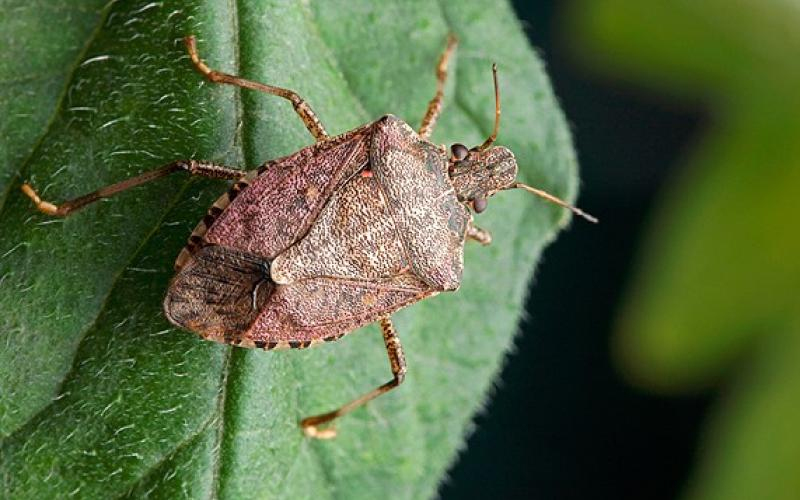
The brown marmorated stink bug is identifiable by the white bands on its antennae and invades Maryland homes in large numbers each fall and winter, seeking warmth.
Spotted Lanternfly
The spotted lanternfly (SLF) is an invasive insect from China that feeds on the sap of a wide variety of plants, including forest trees such as black walnut, maple, birch, and willow, as well as important agricultural crops such as grapes, hops, apples, and cherries. SLF eggs hatch in spring as black nymphs with white spots, and after feeding all summer, they turn bright red with white and black markings. As adults, they are about an inch long with grayish-brown forewings covered in black spots and bright red hindwings.
Residents are likely to notice spotted lanternflies because they are large, brightly colored, and tend to congregate in large numbers. The sticky honeydew they drop during feeding can turn black with sooty mold and become a nuisance on decks, patios, or vehicles.
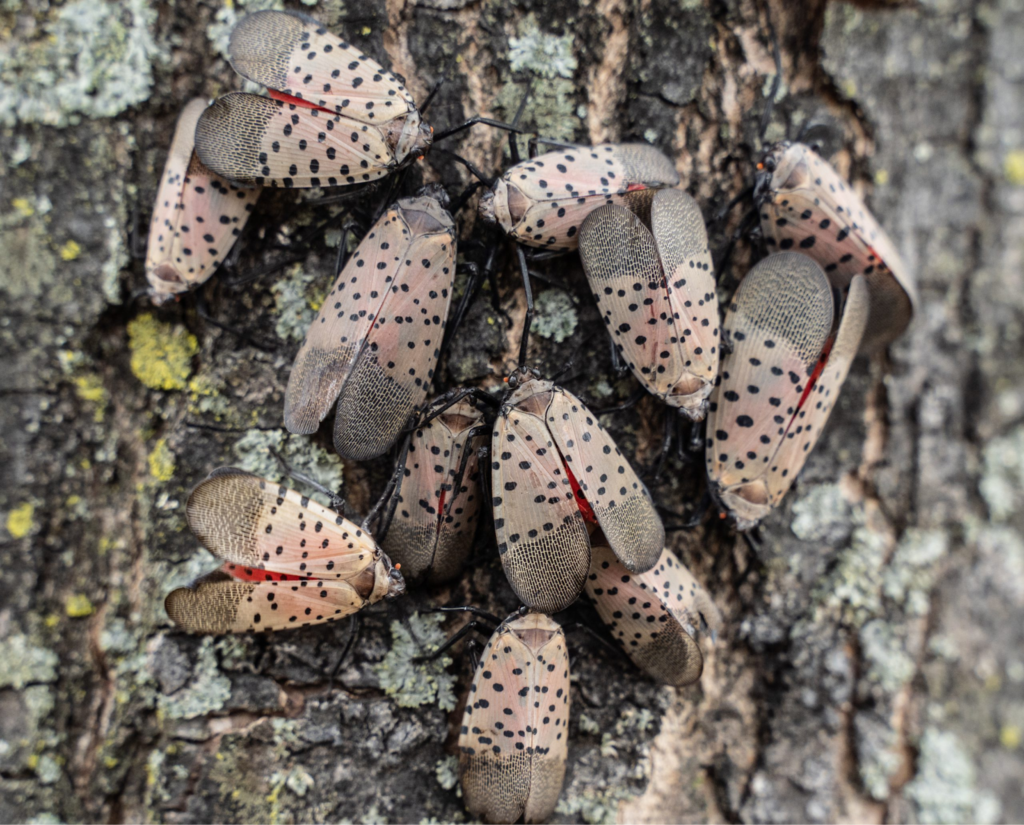
Spotted lanternflies congregate in large numbers and leave behind sticky honeydew that turns into black sooty mold, damaging plants and fouling outdoor surfaces.
Emerald Ash Borer
The emerald ash borer (EAB) is an invasive pest from Asia that kills ash trees. It was first introduced into Prince George’s County in 2003 and was confirmed to be infesting ash trees on the Eastern Shore in 2015. Unlike the stink bug or spotted lanternfly, the EAB is largely invisible until serious damage has occurred. The presence of the emerald ash borer typically goes undetected until trees show signs of infestation. Usually, the upper third of a tree will thin and then die back, followed by a large number of shoots or branches arising below the dead portions of the trunk.
The larvae eat the cambium layer of the tree in a zigzag pattern, disrupting the tree’s ability to transport water and nutrients. Once a tree has lost more than 30% of its canopy or branch structure, it is generally considered beyond recovery with insecticide treatment. The telltale sign for EAB is the “D” shaped emergence holes in bark.

The emerald ash borer works silently inside tree bark and often goes undetected until an ash tree is already dying, making early inspection critical.
Japanese Beetle
Japanese beetles feed on more than 300 plant species and have become the number one turfgrass pest in the United States, causing millions of dollars in damage. The insect has copper-colored wings that serve as a shell when not flying. In Maryland, Japanese beetle grubs damage lawns by feeding on grass roots underground, while adult beetles skeletonize the leaves of ornamental plants, fruit trees, and gardens from late spring through summer.
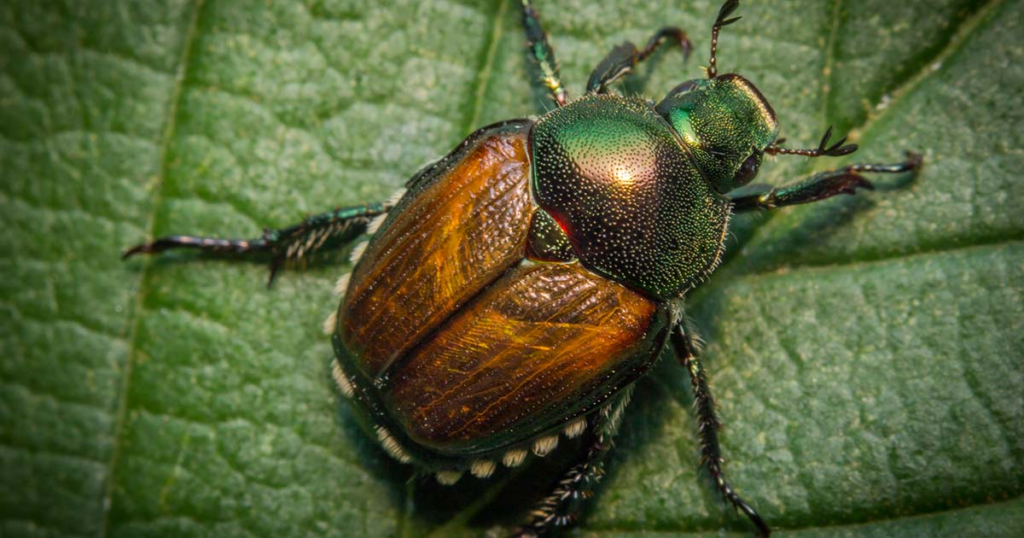
Japanese beetles damage Maryland properties on two fronts simultaneously, with grubs destroying lawn roots underground and adults stripping plant foliage above ground.
Asian Tiger Mosquito
In Maryland, the Asian tiger mosquito was first discovered in Baltimore City in 1987 and has since spread to all Maryland counties except Allegany and Garrett. This mosquito is black with white striping along its legs and body, and is much more common in urban areas than the native species. It can lay and hatch eggs with far less standing water than domestic mosquito species, thriving in water found in children’s toys, lawn furniture, or even a disposable cup.
Unlike most mosquitoes, which are active at dawn and dusk, the Asian tiger mosquito bites aggressively during the day, significantly increasing the contact people have with it around their homes.
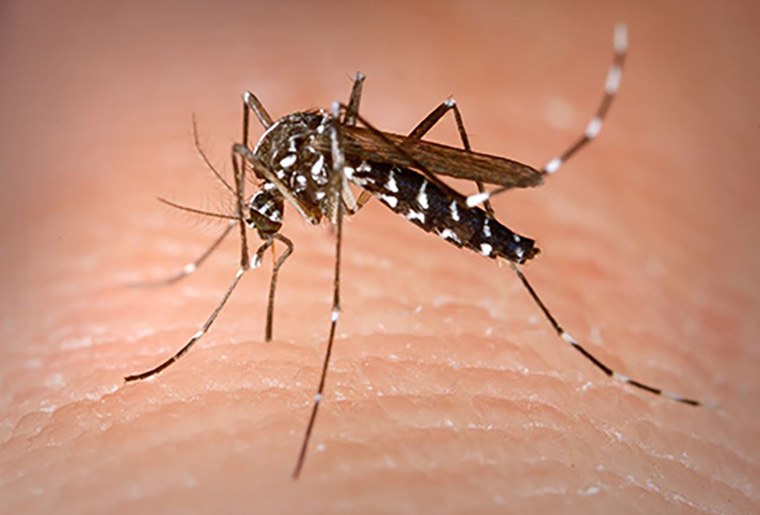
Unlike native mosquitoes, the Asian tiger mosquito bites during daylight hours and breeds in tiny amounts of standing water, making it far harder to avoid and control around Maryland homes.
Spongy Moth (Formerly Gypsy Moth)
The spongy moth is a highly destructive invasive species in forests and urban trees across Maryland and much of the eastern United States. Spongy moth caterpillars eat the leaves of trees, especially oaks. When populations are high, they eat most of the leaves off trees, weakening them and making them more vulnerable to other pests and diseases, as well as drought, heat, and urban pollution. In many cases, spongy moth damage kills mature trees. The spongy moth was introduced to the United States from Europe in 1869, but did not establish a serious presence in Maryland until the 1980s.
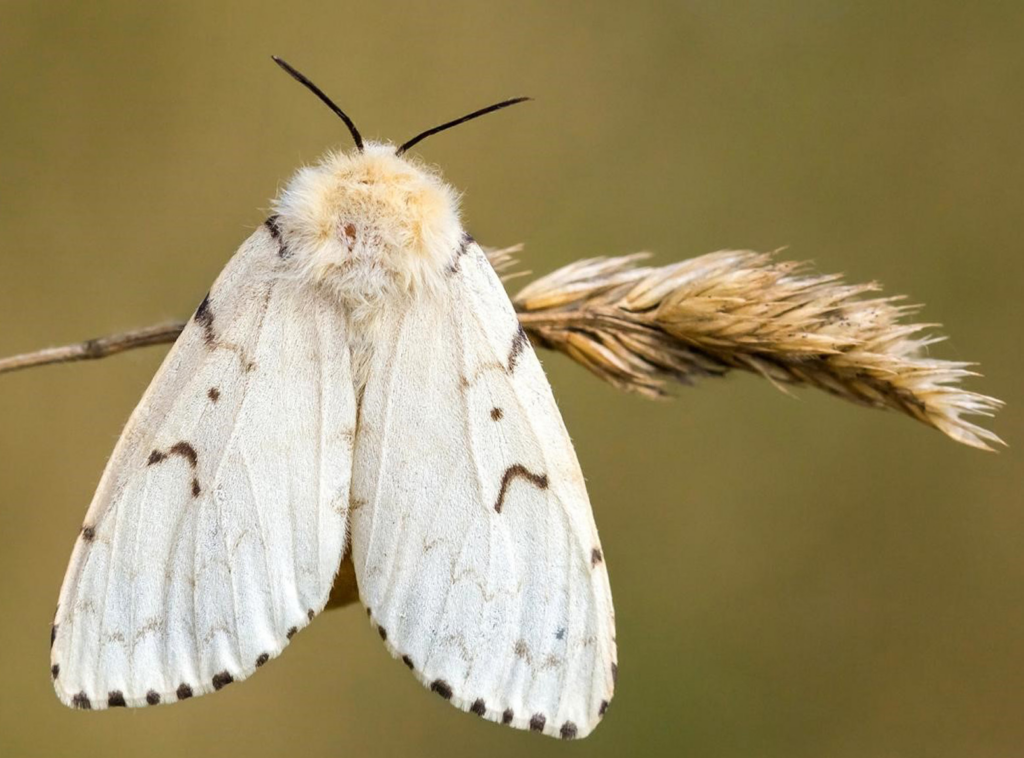
Spongy moth caterpillars can completely strip mature oak trees of their leaves, leaving them weakened and vulnerable to disease, drought, and death.
How Do These Invasive Bugs Differ From Each Other?
These pests are often lumped together under the “invasive bug” label, but they cause very different problems and require different responses.
The brown marmorated stink bug is primarily a home invader and garden pest. It does not sting, bite, or spread disease, but it can release a foul odor when disturbed and may congregate in large numbers inside walls and attics during colder months. The spotted lanternfly, by contrast, stays largely outdoors but can devastate gardens and agricultural crops through its sap-sucking feeding behavior.
The emerald ash borer and spongy moth are tree threats. The EAB targets ash trees specifically, working silently from within the bark until the damage becomes irreversible. The spongy moth is less discriminating, defoliating a wide range of tree species with its caterpillars. The Japanese beetle operates on two fronts: its larvae destroy lawns beneath the soil while adults feed aggressively on foliage above ground.
The Asian tiger mosquito stands out from the others because it poses a direct health concern. It is a known vector for diseases including dengue, chikungunya, and Zika virus, though transmission rates in Maryland remain low.
What Are the Best Solutions for Invasive Bugs in Maryland?
Effective control depends on identifying the pest correctly and responding with targeted methods.
1. For brown marmorated stink bugs, sealing entry points around windows, doors, and utility lines before fall is the most effective prevention strategy. Indoor populations can be managed using vacuuming and insecticide treatments along entry zones.
2. For spotted lanternfly, control options available to homeowners include soil drenches applied around the tree trunk, bark sprays applied to the lower trunk, and direct sprays applied to the insects themselves. Reporting sightings to the Maryland Department of Agriculture is also encouraged to help track the spread.
3. For the emerald ash borer, treatments should be made after ash trees are finished flowering to protect pollinators. Homeowners should hire a reputable, insured, licensed arborist or tree company to remove infested or dead ash trees or to discuss control or prevention.
4. Japanese beetle populations can be reduced through grub control treatments applied to lawns in late summer, targeting larvae before they mature. For Asian tiger mosquitoes, eliminating standing water around the property is the single most effective preventive measure, combined with professional mosquito treatments during peak seasons.
5. For spongy moths, Maryland participates in a control program with both the Maryland Department of Agriculture and the US Forest Service that includes aerial treatments in heavily impacted areas, though individual homeowners benefit most from professional monitoring and targeted insecticide application.
Why Connor’s Pest Pros Is the Right Call for Maryland Pest Problems

Connor’s Pest Pros provides same-day invasive bug control across the D.C. metro area, with customized seasonal treatment plans and a 100% satisfaction guarantee for Maryland homeowners.
No two invasive bugs in Maryland cause the same kind of damage or respond to the same treatment. Stink bugs and spotted lanternflies require exclusion and targeted sprays; tree pests like the emerald ash borer and spongy moth demand early action before damage becomes irreversible; Japanese beetles call for grub treatments and foliage control; and Asian tiger mosquitoes need standing water elimination combined with professional seasonal treatment.
Connor’s Pest Pros handles all of these as a family-owned D.C. metro area business with 415+ five-star reviews and a 100% satisfaction guarantee. Whether you are dealing with a seasonal invader or a persistent infestation, our team offers same-day service, pet- and child-friendly treatments, and customized plans that adjust as Maryland’s pest pressures change throughout the year.
Schedule Your Free Inspection Today!
Frequently Asked Questions (FAQs)
Are invasive bugs in Maryland dangerous to humans?
Most invasive bugs in Maryland pose minimal direct health risks to people. The Asian tiger mosquito is the most notable exception, as it can transmit certain viruses. Stink bugs and spotted lanternflies are primarily nuisances. That said, any pest that damages your home’s structure or enters living spaces warrants professional attention.
How do I tell the difference between a brown marmorated stink bug and a native stink bug?
The easiest way is to look at the antennae. The brown marmorated stink bug has white bands on its antennae, unlike the native stink bug. The BMSB also has alternating light and dark bands along the edge of its abdomen, giving it a slightly mottled appearance compared to its native relatives.
What should I do if I find spotted lanternfly on my property?
If you spot a spotted lanternfly in Maryland, you should report it to the Maryland Department of Agriculture. You can also physically destroy egg masses and adult insects on your property. Removing or treating the tree-of-heaven, the pest’s preferred host plant, can help reduce their presence on your land significantly.
Can invasive insects be fully eliminated from Maryland?
Full eradication of established invasive insects is generally not realistic at the state level, as agencies acknowledge that stopping their spread entirely is extremely difficult. For individual properties, professional pest control treatments can manage populations effectively and prevent infestations from causing serious damage to your home or property.
How does Connor’s Pest Pros handle invasive insect problems in the D.C. metro area?
Connor’s Pest Pros takes a targeted approach to invasive insect problems. As a family-owned business with a National Pest Management Association membership and an Angi Super Service Award, we offer customized seasonal pest control plans, specialized treatments for the toughest infestations, and humane wildlife removal for pests that make it indoors. We offer same-day service and free re-treatments until you’re fully satisfied.
*Price estimates reflect current market costs and may vary based on your specific situation. For a personalized quote tailored to your needs, contact us directly or request your FREE estimate today!